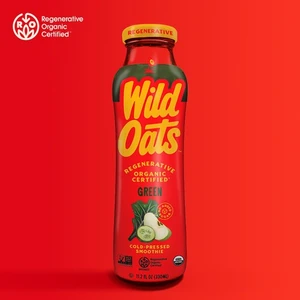
Pear Juice - 11.2 oz
Wild Oats
$4.49
Below are the available bulk discount rates for each individual item when you purchase a certain amount
- Buy 2 - 5 and get 5% off
- Buy 6 - 11 and get 10% off
- Buy 12 or above and get 20% off
(No reviews yet)

Write a Review

Wild Oats
Pear Juice - 11.2 oz
One ingredient. One fruit. Zero compromise. Wild Oats Pear Juice is pressed from organic pears and nothing else — no added sugars, no concentrates, no flavor enhancers — just the clean, rounded sweetness of real fruit in a single-serve bottle.
- Perfect for desk lunches, school bags, or an afternoon reset — a 11.2 fl oz single-serve format that travels without fuss and tastes like a pear, not a lab.
- Regenerative Organic Certified Bronze — the highest-bar farm certification in the food system, requiring USDA Organic compliance plus verified fair living wages for farmers and meaningful soil health standards.
- Vegan, Kosher, Non-GMO Project Verified, and Certified Fairtrade — stacked certifications from independent third-party bodies, not self-reported claims.
When a juice is made from one ingredient, every sip either delivers or it doesn't. Wild Oats Pear Juice delivers — a soft, naturally balanced sweetness that comes from the fruit itself, not from added sugar, natural flavoring, or concentrate.
The single-serve 11.2 fl oz bottle contains Organic Pear Juice and nothing else. No blends, no fillers, no fortifying agents. What you taste is what was pressed. The pears are grown under Regenerative Organic Certified Bronze standards, a certification that stacks three pillars USDA Organic alone doesn't cover: healthy soil practices (no synthetic pesticides, herbicides, chemical fertilizers, monocropping, or deforestation), fair living wages and safe working conditions for every farmer and worker in the supply chain, and ethical animal welfare standards on the farm. It is audited and issued by the Regenerative Organic Alliance — not self-declared.
For shoppers who read every label: this product also carries Non-GMO Project Verified, Certified Fairtrade (KIWA-audited), Orthodox Union Kosher, and USDA Organic certifications — five independent third-party validations on a single-ingredient juice. That's an unusual degree of accountability for what is, at heart, a lunchbox staple.
Store at room temperature. Refrigerate after opening and consume promptly. Suitable for vegan, Kosher, and Non-GMO lifestyles.
Ingredients: Organic Pear Juice.
Common Questions
How does this pear juice compare to conventional pear juice from concentrate?
Most pear juices on supermarket shelves are made from concentrate, a process that involves evaporating water from the juice, shipping the dense syrup, then reconstituting it with water before bottling. That process can degrade heat-sensitive polyphenols and volatile aromatic compounds responsible for fresh fruit flavor. This juice is not from concentrate, meaning the pears are pressed and the liquid goes directly into the bottle without that evaporation and reconstitution step. Conventional pear juices also frequently contain added sugars or natural flavoring agents to compensate for flavor loss; this product lists one ingredient — Organic Pear Juice — with no additions.
What natural compounds in pear juice are responsible for its sweetness, and is that sugar different from added sugar?
Pears are naturally high in fructose, glucose, and sorbitol — three sugars present in the fruit itself before any processing. Sorbitol, which makes up a meaningful portion of pear sugar, is a sugar alcohol that is absorbed more slowly in the digestive tract than sucrose, which partly explains why pear juice has a softer, less sharp sweetness than apple or grape juice. Because this product contains no added sugars, sweeteners, or flavoring agents, the entire sugar profile comes from those naturally occurring compounds in the pressed fruit. The distinction matters on a label because added sugars and intrinsic fruit sugars are metabolized similarly, but the absence of additions confirms nothing has been used to artificially boost sweetness or mask flavor deficiencies from lower-quality fruit.
What does Regenerative Organic Certified Bronze actually require, and how is it different from USDA Organic?
USDA Organic certification prohibits synthetic pesticides, synthetic fertilizers, and GMOs, but it does not set standards for soil health practices beyond that baseline, does not require fair wages or safe working conditions for farmworkers, and does not address animal welfare on farms. Regenerative Organic Certified, issued by the Regenerative Organic Alliance, adds three distinct pillars on top of the USDA Organic foundation: soil health and land management practices that actively build organic matter and biodiversity, farmer and worker fairness covering living wages and safe conditions, and animal welfare standards. Bronze is the entry tier of a three-level system (Bronze, Silver, Gold), meaning the farm meets all foundational requirements and is on a documented improvement pathway. The certification is audited by third-party inspectors, not self-declared by the brand.
How can I independently verify the certifications listed on this product?
Each certification on this product is issued by a named third-party organization with a public-facing registry. USDA Organic certificates can be looked up through the USDA's organic integrity database at ams.usda.gov using the operation name or certificate number. Non-GMO Project Verified products appear in the searchable product database at nongmoproject.org. Orthodox Union Kosher certification can be confirmed at oukosher.org. Fairtrade certification audited by KIWA can be cross-referenced through Fairtrade International's producer directory. Regenerative Organic Certified farms and brands are listed at regenorganic.org. Five independent auditing bodies means the claims on this label are not reliant on any single organization's oversight.
Is pear juice suitable for people following specific diets like low-FODMAP or those managing fructose sensitivity?
Pear juice is not typically recommended for people following a low-FODMAP diet or those with diagnosed fructose malabsorption. Pears contain high levels of fructose and sorbitol, both of which are classified as FODMAPs — fermentable carbohydrates that can cause digestive discomfort in sensitive individuals. Monash University, which maintains the primary low-FODMAP food database, lists pear juice as a high-FODMAP food. For people without fructose sensitivity, the natural sorbitol content simply means the juice digests more gradually than high-sucrose beverages. Anyone managing IBS, fructose malabsorption, or following a clinical low-FODMAP protocol should consult a dietitian before including pear juice regularly.
What is the Fairtrade certification on this product, and who audits it?
Fairtrade certification is an international standard designed to ensure that farmers and workers in the supply chain receive a minimum price for their goods and a Fairtrade Premium — an additional sum paid on top of the market price that producer groups direct toward community or business investments. The certification covers labor conditions, pricing floors, and democratic organization of farming cooperatives. On this product, the Fairtrade audit is conducted by KIWA, an accredited certification body that operates independently of the brand and conducts on-site inspections of farms and supply chain participants. This is distinct from a brand self-reporting fair trade practices — KIWA's involvement means a third party has verified compliance against the Fairtrade International standard.
Can this juice be used as an ingredient in cooking or baking, and does the single-ingredient formulation matter for those uses?
Yes, pure pear juice works well as a liquid ingredient in contexts where you want mild, naturally sweet fruit flavor without added sugar skewing the result. It can be used to deglaze a pan when cooking pork or poultry, as a poaching liquid for fruit or delicate fish, as the liquid base in vinaigrettes alongside apple cider vinegar, or as a partial sugar substitute in baked goods where you reduce other liquids proportionally. Because this juice contains no flavor additives, concentrates, or sweeteners, it behaves predictably — the flavor you taste from the bottle is the flavor you get in the finished dish, without an artificial aftertaste. If substituting for a sweetener, keep in mind that pear juice is less sweet by volume than refined sugar, so recipes may require adjustment.
The single-serve 11.2 fl oz bottle contains Organic Pear Juice and nothing else. No blends, no fillers, no fortifying agents. What you taste is what was pressed. The pears are grown under Regenerative Organic Certified Bronze standards, a certification that stacks three pillars USDA Organic alone doesn't cover: healthy soil practices (no synthetic pesticides, herbicides, chemical fertilizers, monocropping, or deforestation), fair living wages and safe working conditions for every farmer and worker in the supply chain, and ethical animal welfare standards on the farm. It is audited and issued by the Regenerative Organic Alliance — not self-declared.
For shoppers who read every label: this product also carries Non-GMO Project Verified, Certified Fairtrade (KIWA-audited), Orthodox Union Kosher, and USDA Organic certifications — five independent third-party validations on a single-ingredient juice. That's an unusual degree of accountability for what is, at heart, a lunchbox staple.
Store at room temperature. Refrigerate after opening and consume promptly. Suitable for vegan, Kosher, and Non-GMO lifestyles.
Ingredients: Organic Pear Juice.
Common Questions
How does this pear juice compare to conventional pear juice from concentrate?
Most pear juices on supermarket shelves are made from concentrate, a process that involves evaporating water from the juice, shipping the dense syrup, then reconstituting it with water before bottling. That process can degrade heat-sensitive polyphenols and volatile aromatic compounds responsible for fresh fruit flavor. This juice is not from concentrate, meaning the pears are pressed and the liquid goes directly into the bottle without that evaporation and reconstitution step. Conventional pear juices also frequently contain added sugars or natural flavoring agents to compensate for flavor loss; this product lists one ingredient — Organic Pear Juice — with no additions.
What natural compounds in pear juice are responsible for its sweetness, and is that sugar different from added sugar?
Pears are naturally high in fructose, glucose, and sorbitol — three sugars present in the fruit itself before any processing. Sorbitol, which makes up a meaningful portion of pear sugar, is a sugar alcohol that is absorbed more slowly in the digestive tract than sucrose, which partly explains why pear juice has a softer, less sharp sweetness than apple or grape juice. Because this product contains no added sugars, sweeteners, or flavoring agents, the entire sugar profile comes from those naturally occurring compounds in the pressed fruit. The distinction matters on a label because added sugars and intrinsic fruit sugars are metabolized similarly, but the absence of additions confirms nothing has been used to artificially boost sweetness or mask flavor deficiencies from lower-quality fruit.
What does Regenerative Organic Certified Bronze actually require, and how is it different from USDA Organic?
USDA Organic certification prohibits synthetic pesticides, synthetic fertilizers, and GMOs, but it does not set standards for soil health practices beyond that baseline, does not require fair wages or safe working conditions for farmworkers, and does not address animal welfare on farms. Regenerative Organic Certified, issued by the Regenerative Organic Alliance, adds three distinct pillars on top of the USDA Organic foundation: soil health and land management practices that actively build organic matter and biodiversity, farmer and worker fairness covering living wages and safe conditions, and animal welfare standards. Bronze is the entry tier of a three-level system (Bronze, Silver, Gold), meaning the farm meets all foundational requirements and is on a documented improvement pathway. The certification is audited by third-party inspectors, not self-declared by the brand.
How can I independently verify the certifications listed on this product?
Each certification on this product is issued by a named third-party organization with a public-facing registry. USDA Organic certificates can be looked up through the USDA's organic integrity database at ams.usda.gov using the operation name or certificate number. Non-GMO Project Verified products appear in the searchable product database at nongmoproject.org. Orthodox Union Kosher certification can be confirmed at oukosher.org. Fairtrade certification audited by KIWA can be cross-referenced through Fairtrade International's producer directory. Regenerative Organic Certified farms and brands are listed at regenorganic.org. Five independent auditing bodies means the claims on this label are not reliant on any single organization's oversight.
Is pear juice suitable for people following specific diets like low-FODMAP or those managing fructose sensitivity?
Pear juice is not typically recommended for people following a low-FODMAP diet or those with diagnosed fructose malabsorption. Pears contain high levels of fructose and sorbitol, both of which are classified as FODMAPs — fermentable carbohydrates that can cause digestive discomfort in sensitive individuals. Monash University, which maintains the primary low-FODMAP food database, lists pear juice as a high-FODMAP food. For people without fructose sensitivity, the natural sorbitol content simply means the juice digests more gradually than high-sucrose beverages. Anyone managing IBS, fructose malabsorption, or following a clinical low-FODMAP protocol should consult a dietitian before including pear juice regularly.
What is the Fairtrade certification on this product, and who audits it?
Fairtrade certification is an international standard designed to ensure that farmers and workers in the supply chain receive a minimum price for their goods and a Fairtrade Premium — an additional sum paid on top of the market price that producer groups direct toward community or business investments. The certification covers labor conditions, pricing floors, and democratic organization of farming cooperatives. On this product, the Fairtrade audit is conducted by KIWA, an accredited certification body that operates independently of the brand and conducts on-site inspections of farms and supply chain participants. This is distinct from a brand self-reporting fair trade practices — KIWA's involvement means a third party has verified compliance against the Fairtrade International standard.
Can this juice be used as an ingredient in cooking or baking, and does the single-ingredient formulation matter for those uses?
Yes, pure pear juice works well as a liquid ingredient in contexts where you want mild, naturally sweet fruit flavor without added sugar skewing the result. It can be used to deglaze a pan when cooking pork or poultry, as a poaching liquid for fruit or delicate fish, as the liquid base in vinaigrettes alongside apple cider vinegar, or as a partial sugar substitute in baked goods where you reduce other liquids proportionally. Because this juice contains no flavor additives, concentrates, or sweeteners, it behaves predictably — the flavor you taste from the bottle is the flavor you get in the finished dish, without an artificial aftertaste. If substituting for a sweetener, keep in mind that pear juice is less sweet by volume than refined sugar, so recipes may require adjustment.
- __Storage_Location:
- Dry
- __Volume:
- 500
- __badge:
- Regenerative
- __Owner:
- TCFarm