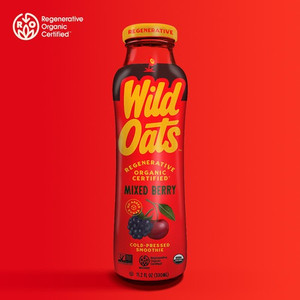
Green Smoothie - 11.2 oz
Wild Oats
$4.49
Below are the available bulk discount rates for each individual item when you purchase a certain amount
- Buy 2 - 5 and get 5% off
- Buy 6 - 11 and get 10% off
- Buy 12 or above and get 20% off
(No reviews yet)

Write a Review

Wild Oats
Green Smoothie - 11.2 oz
Eight certified-organic ingredients. Zero fillers. One bottle that punches harder than your morning coffee routine.
Wild Oats' Green Smoothie presses together Organic Kale, Cucumber, Spinach, Celery, Parsley, Mint, Lemon, and Apple — sourced from farms verified under Regenerative Organic Certified Bronze, the most rigorous farm-to-bottle standard in the industry. ROC Bronze means no synthetic pesticides or herbicides, fair living wages for every farmworker in the supply chain, and soil-health practices audited by a third party.
Wild Oats' Green Smoothie presses together Organic Kale, Cucumber, Spinach, Celery, Parsley, Mint, Lemon, and Apple — sourced from farms verified under Regenerative Organic Certified Bronze, the most rigorous farm-to-bottle standard in the industry. ROC Bronze means no synthetic pesticides or herbicides, fair living wages for every farmworker in the supply chain, and soil-health practices audited by a third party.
- Cold-pressed flavor profile built for people who want greens without the grit — cucumber and mint forward, balanced by apple and lemon, with celery adding savory depth.
- Stacked certifications: Regenerative Organic Certified Bronze, USDA Organic, Non-GMO Project Verified, Certified Fairtrade, Kosher, and Vegan — a combination almost no shelf smoothie can match.
- Suitable for vegan, plant-based, gluten-free, and dairy-free lifestyles; Kosher certified by Orthodox Union.
Wild Oats' Green Smoothie is built from eight certified-organic, cold-pressed ingredients — and nothing else. No sweeteners, no concentrates beyond the listed juices, no stabilizers, no colors. What you're holding is the kind of bottle that the "green juice" category has been promising for years and rarely delivers.
The 11.2 fl oz single-serve format presses together Organic Kale Juice, Organic Cucumber Puree, Organic Apple Juice, Organic Spinach Juice, Organic Mint Juice, Organic Celery Juice, Organic Lemon Juice, and Organic Parsley Juice into a profile the brand describes as "crisp, savory, and aggressively fresh." Apple and lemon round the bitter edges of kale and parsley; cucumber and mint cool the whole thing down; celery adds the savory backbone that makes this drink feel like food rather than a supplement.
What sets this product apart from grocery-aisle green blends is its Regenerative Organic Certified Bronze standard — a third-party audit that goes well beyond USDA Organic. ROC Bronze requires demonstrated soil-health practices (no synthetic pesticides, herbicides, chemical fertilizers, monocropping, or deforestation), verified fair living wages and safe working conditions for all farmers and workers, and ongoing third-party oversight. USDA Organic alone does not require any of those social or soil-depth criteria. Wild Oats also carries Certified Fairtrade verification, meaning farmworker wages and conditions have been independently audited for equity — a claim almost no competitor in the bottled smoothie aisle can make.
The full certification stack: Regenerative Organic Certified Bronze · USDA Organic · Non-GMO Project Verified · Certified Fairtrade · Orthodox Union Kosher · Vegan · KIWA.
Drink straight from the bottle chilled, shake over ice as a base for a savory green gazpacho, or blend with frozen banana and ginger for a smoothie bowl. Works especially well as a midday reset or pre-workout green hit for anyone avoiding sugar-forward fruit-blend drinks.
Suitable for vegan, plant-based, gluten-free, dairy-free, and Kosher diets. Store at room temperature before opening; refrigerate after opening and consume promptly.
Ingredients: Organic Kale Juice, Organic Cucumber Puree, Organic Apple Juice, Organic Spinach Puree, Organic Mint Juice, Organic Celery Juice, Organic Lemon Juice, And Organic Parsley Juice.
Common Questions
How does this green smoothie compare nutritionally to a homemade green juice made from whole vegetables?
Cold-pressing whole vegetables into juice removes most of the insoluble fiber but concentrates water-soluble vitamins, minerals, and phytonutrients into a smaller, more bioavailable volume. Kale juice, for example, delivers concentrated amounts of vitamin K1 — a single cup of raw kale contains roughly 550 mcg of K1, and juicing condenses that further by removing pulp mass. Spinach is one of the richest dietary sources of lutein and zeaxanthin, two carotenoids associated with macular health, and those compounds are retained in cold-pressed juice. A homemade blend using non-organic produce may contain pesticide residues on the exterior of vegetables like celery and cucumber, both of which consistently appear on the Environmental Working Group's higher-residue lists — this product's USDA Organic certification means synthetic pesticides and herbicides were prohibited at the farm level. The trade-off versus whole vegetables is fiber: if gut motility or satiety from fiber is a priority, eating whole leafy greens alongside this drink is worth considering.
What does Regenerative Organic Certified Bronze actually require, and how is it different from USDA Organic?
USDA Organic certification prohibits synthetic pesticides, synthetic fertilizers, and GMOs, but it does not mandate any specific soil-health practices, does not require carbon sequestration efforts, and has no enforceable social standards for farmworker wages or working conditions. Regenerative Organic Certified, administered by the Regenerative Organic Alliance, adds three additional pillars: soil health (requiring practices like cover cropping, composting, and crop rotation that actively rebuild soil organic matter), animal welfare (if applicable), and social fairness (verified living wages, safe conditions, and worker empowerment). The Bronze tier is the entry level of three tiers — Bronze, Silver, and Gold — and represents a farm that has passed an independent third-party audit confirming baseline performance across those pillars. Because ROC requires USDA Organic as a prerequisite, this product meets both standards simultaneously. No single USDA Organic label tells you anything about the soil practices or the people who harvested the ingredients — ROC Bronze does.
What is Certified Fairtrade, and why does it matter for a bottled juice product?
Fairtrade certification, issued by Fairtrade International and its national affiliates, is an independent audit system that verifies farmers and workers in the supply chain receive a minimum price floor for their goods and, where applicable, a Fairtrade Premium — an additional sum paid directly to worker communities for investment in schools, healthcare, or farm improvements. For a multi-ingredient juice like this one, ingredients sourced from tropical or developing-region farms (such as certain citrus or specialty crops) carry particular risk of wage exploitation and unsafe labor practices that standard organic certification does nothing to address. The certification requires documented supply chain traceability back to the producer, meaning the brand cannot simply claim fair trade principles — a named certifying body has audited the chain. Very few bottled smoothie or green juice brands carry Fairtrade verification alongside their organic claims, making this a meaningful differentiator in a category where supply chain ethics are rarely disclosed. The KIWA certification listed on this product is an accredited inspection and certification body that provides additional independent verification of agricultural and quality standards.
Is this smoothie suitable for a low-sugar or low-carbohydrate diet?
The ingredient list includes Organic Apple Juice, which is the primary natural sugar source in this blend — apple juice contains roughly 24–28 grams of sugar per cup (240 ml), though the concentration here depends on the proportion used across the 11.2 fl oz total volume. People following strict ketogenic protocols (typically under 20–50 grams net carbohydrates per day) should check the nutrition facts panel for total sugar and net carb counts before incorporating this regularly, since fruit juice can contribute meaningful carbohydrate load even in a green-forward blend. For paleo or whole-food plant-based approaches where natural fruit sugars are not restricted, the ingredient profile — eight whole-food organic juices and purees, no additives, no concentrates beyond the listed ingredients — aligns well with the framework. The savory profile from kale, celery, parsley, and cucumber means the apple and lemon are present for balance rather than sweetness-forward flavor, which may make portion management more intuitive than with fruit-dominant smoothies.
What specific compounds in kale and spinach juice have documented health effects, and how do they work?
Kale is one of the most concentrated dietary sources of sulforaphane precursors — specifically glucoraphanin, which converts to sulforaphane via the enzyme myrosinase when the cell walls are disrupted during juicing or chewing. Sulforaphane has been studied extensively for its activation of the Nrf2 pathway, a cellular signaling mechanism that upregulates the body's own antioxidant and detoxification enzymes. Spinach provides high concentrations of nitrates (not to be confused with synthetic nitrites added to cured meats), which the body converts to nitric oxide — a vasodilator associated with improved blood flow and reduced resting blood pressure in multiple controlled trials, with effects observed at doses as low as 300–500 mg of dietary nitrate. Parsley is one of the richest known sources of apigenin, a flavonoid with studied anti-inflammatory properties, and provides exceptionally high vitamin K1 content — approximately 1,640 mcg per 100 grams of fresh parsley. Celery contains phthalides, a class of compounds that animal and limited human studies suggest may contribute to smooth muscle relaxation in arterial walls. Together, these mechanisms make the ingredient stack more pharmacologically active than the ingredient list might suggest to a casual reader.
Can this drink be used as a base or ingredient in cooking, and does heat affect its nutritional value?
Yes — the clean ingredient list (no stabilizers, gums, or artificial flavors) makes it a functional cooking ingredient without off-flavors from additives. Used cold, it works as a liquid base for a savory green gazpacho alongside diced cucumber, avocado, and a pinch of sea salt, or as the liquid component in a smoothie bowl blended with frozen banana and fresh ginger. As a salad dressing base, whisking it with tahini, lemon zest, and garlic produces a nutrient-dense green dressing without added sugars. If used in cooked applications — for example, as a braising liquid for grains or as a base for a chilled soup that is briefly heated — be aware that heat above roughly 70°C (158°F) will degrade heat-sensitive compounds like vitamin C (lemon juice is the primary source here) and will denature the myrosinase enzyme in kale juice, reducing sulforaphane conversion. Water-soluble B vitamins and minerals like potassium and magnesium are more stable to moderate heat. For maximum retention of the volatile aromatic compounds in mint and parsley, use cold or add after any cooking step.
How can a buyer independently verify the certifications listed on this product?
Each certification body on this product maintains a publicly searchable database. USDA Organic certificates can be verified through the USDA's organic integrity database at ams.usda.gov/organic-integrity, where you can search by company or certificate number. Non-GMO Project Verified products are searchable at nongmoproject.org/find-non-gmo. Regenerative Organic Certified status can be confirmed at regenorganic.org, which lists certified operations by tier. Fairtrade certification can be checked through the Fairtrade International directory at flocert.net or the relevant national Fairtrade organization. Orthodox Union Kosher certification (the OU symbol) is verifiable at oukosher.org/find-kosher. KIWA is an internationally accredited inspection and certification organization whose certificates can be cross-referenced through their website or through national accreditation bodies. If any certificate has lapsed or the product has changed formulation, these databases will reflect the current status — checking them takes under two minutes per certification and provides confirmation independent of anything printed on the label.
The 11.2 fl oz single-serve format presses together Organic Kale Juice, Organic Cucumber Puree, Organic Apple Juice, Organic Spinach Juice, Organic Mint Juice, Organic Celery Juice, Organic Lemon Juice, and Organic Parsley Juice into a profile the brand describes as "crisp, savory, and aggressively fresh." Apple and lemon round the bitter edges of kale and parsley; cucumber and mint cool the whole thing down; celery adds the savory backbone that makes this drink feel like food rather than a supplement.
What sets this product apart from grocery-aisle green blends is its Regenerative Organic Certified Bronze standard — a third-party audit that goes well beyond USDA Organic. ROC Bronze requires demonstrated soil-health practices (no synthetic pesticides, herbicides, chemical fertilizers, monocropping, or deforestation), verified fair living wages and safe working conditions for all farmers and workers, and ongoing third-party oversight. USDA Organic alone does not require any of those social or soil-depth criteria. Wild Oats also carries Certified Fairtrade verification, meaning farmworker wages and conditions have been independently audited for equity — a claim almost no competitor in the bottled smoothie aisle can make.
The full certification stack: Regenerative Organic Certified Bronze · USDA Organic · Non-GMO Project Verified · Certified Fairtrade · Orthodox Union Kosher · Vegan · KIWA.
Drink straight from the bottle chilled, shake over ice as a base for a savory green gazpacho, or blend with frozen banana and ginger for a smoothie bowl. Works especially well as a midday reset or pre-workout green hit for anyone avoiding sugar-forward fruit-blend drinks.
Suitable for vegan, plant-based, gluten-free, dairy-free, and Kosher diets. Store at room temperature before opening; refrigerate after opening and consume promptly.
Ingredients: Organic Kale Juice, Organic Cucumber Puree, Organic Apple Juice, Organic Spinach Puree, Organic Mint Juice, Organic Celery Juice, Organic Lemon Juice, And Organic Parsley Juice.
Common Questions
How does this green smoothie compare nutritionally to a homemade green juice made from whole vegetables?
Cold-pressing whole vegetables into juice removes most of the insoluble fiber but concentrates water-soluble vitamins, minerals, and phytonutrients into a smaller, more bioavailable volume. Kale juice, for example, delivers concentrated amounts of vitamin K1 — a single cup of raw kale contains roughly 550 mcg of K1, and juicing condenses that further by removing pulp mass. Spinach is one of the richest dietary sources of lutein and zeaxanthin, two carotenoids associated with macular health, and those compounds are retained in cold-pressed juice. A homemade blend using non-organic produce may contain pesticide residues on the exterior of vegetables like celery and cucumber, both of which consistently appear on the Environmental Working Group's higher-residue lists — this product's USDA Organic certification means synthetic pesticides and herbicides were prohibited at the farm level. The trade-off versus whole vegetables is fiber: if gut motility or satiety from fiber is a priority, eating whole leafy greens alongside this drink is worth considering.
What does Regenerative Organic Certified Bronze actually require, and how is it different from USDA Organic?
USDA Organic certification prohibits synthetic pesticides, synthetic fertilizers, and GMOs, but it does not mandate any specific soil-health practices, does not require carbon sequestration efforts, and has no enforceable social standards for farmworker wages or working conditions. Regenerative Organic Certified, administered by the Regenerative Organic Alliance, adds three additional pillars: soil health (requiring practices like cover cropping, composting, and crop rotation that actively rebuild soil organic matter), animal welfare (if applicable), and social fairness (verified living wages, safe conditions, and worker empowerment). The Bronze tier is the entry level of three tiers — Bronze, Silver, and Gold — and represents a farm that has passed an independent third-party audit confirming baseline performance across those pillars. Because ROC requires USDA Organic as a prerequisite, this product meets both standards simultaneously. No single USDA Organic label tells you anything about the soil practices or the people who harvested the ingredients — ROC Bronze does.
What is Certified Fairtrade, and why does it matter for a bottled juice product?
Fairtrade certification, issued by Fairtrade International and its national affiliates, is an independent audit system that verifies farmers and workers in the supply chain receive a minimum price floor for their goods and, where applicable, a Fairtrade Premium — an additional sum paid directly to worker communities for investment in schools, healthcare, or farm improvements. For a multi-ingredient juice like this one, ingredients sourced from tropical or developing-region farms (such as certain citrus or specialty crops) carry particular risk of wage exploitation and unsafe labor practices that standard organic certification does nothing to address. The certification requires documented supply chain traceability back to the producer, meaning the brand cannot simply claim fair trade principles — a named certifying body has audited the chain. Very few bottled smoothie or green juice brands carry Fairtrade verification alongside their organic claims, making this a meaningful differentiator in a category where supply chain ethics are rarely disclosed. The KIWA certification listed on this product is an accredited inspection and certification body that provides additional independent verification of agricultural and quality standards.
Is this smoothie suitable for a low-sugar or low-carbohydrate diet?
The ingredient list includes Organic Apple Juice, which is the primary natural sugar source in this blend — apple juice contains roughly 24–28 grams of sugar per cup (240 ml), though the concentration here depends on the proportion used across the 11.2 fl oz total volume. People following strict ketogenic protocols (typically under 20–50 grams net carbohydrates per day) should check the nutrition facts panel for total sugar and net carb counts before incorporating this regularly, since fruit juice can contribute meaningful carbohydrate load even in a green-forward blend. For paleo or whole-food plant-based approaches where natural fruit sugars are not restricted, the ingredient profile — eight whole-food organic juices and purees, no additives, no concentrates beyond the listed ingredients — aligns well with the framework. The savory profile from kale, celery, parsley, and cucumber means the apple and lemon are present for balance rather than sweetness-forward flavor, which may make portion management more intuitive than with fruit-dominant smoothies.
What specific compounds in kale and spinach juice have documented health effects, and how do they work?
Kale is one of the most concentrated dietary sources of sulforaphane precursors — specifically glucoraphanin, which converts to sulforaphane via the enzyme myrosinase when the cell walls are disrupted during juicing or chewing. Sulforaphane has been studied extensively for its activation of the Nrf2 pathway, a cellular signaling mechanism that upregulates the body's own antioxidant and detoxification enzymes. Spinach provides high concentrations of nitrates (not to be confused with synthetic nitrites added to cured meats), which the body converts to nitric oxide — a vasodilator associated with improved blood flow and reduced resting blood pressure in multiple controlled trials, with effects observed at doses as low as 300–500 mg of dietary nitrate. Parsley is one of the richest known sources of apigenin, a flavonoid with studied anti-inflammatory properties, and provides exceptionally high vitamin K1 content — approximately 1,640 mcg per 100 grams of fresh parsley. Celery contains phthalides, a class of compounds that animal and limited human studies suggest may contribute to smooth muscle relaxation in arterial walls. Together, these mechanisms make the ingredient stack more pharmacologically active than the ingredient list might suggest to a casual reader.
Can this drink be used as a base or ingredient in cooking, and does heat affect its nutritional value?
Yes — the clean ingredient list (no stabilizers, gums, or artificial flavors) makes it a functional cooking ingredient without off-flavors from additives. Used cold, it works as a liquid base for a savory green gazpacho alongside diced cucumber, avocado, and a pinch of sea salt, or as the liquid component in a smoothie bowl blended with frozen banana and fresh ginger. As a salad dressing base, whisking it with tahini, lemon zest, and garlic produces a nutrient-dense green dressing without added sugars. If used in cooked applications — for example, as a braising liquid for grains or as a base for a chilled soup that is briefly heated — be aware that heat above roughly 70°C (158°F) will degrade heat-sensitive compounds like vitamin C (lemon juice is the primary source here) and will denature the myrosinase enzyme in kale juice, reducing sulforaphane conversion. Water-soluble B vitamins and minerals like potassium and magnesium are more stable to moderate heat. For maximum retention of the volatile aromatic compounds in mint and parsley, use cold or add after any cooking step.
How can a buyer independently verify the certifications listed on this product?
Each certification body on this product maintains a publicly searchable database. USDA Organic certificates can be verified through the USDA's organic integrity database at ams.usda.gov/organic-integrity, where you can search by company or certificate number. Non-GMO Project Verified products are searchable at nongmoproject.org/find-non-gmo. Regenerative Organic Certified status can be confirmed at regenorganic.org, which lists certified operations by tier. Fairtrade certification can be checked through the Fairtrade International directory at flocert.net or the relevant national Fairtrade organization. Orthodox Union Kosher certification (the OU symbol) is verifiable at oukosher.org/find-kosher. KIWA is an internationally accredited inspection and certification organization whose certificates can be cross-referenced through their website or through national accreditation bodies. If any certificate has lapsed or the product has changed formulation, these databases will reflect the current status — checking them takes under two minutes per certification and provides confirmation independent of anything printed on the label.
- __Storage_Location:
- Dry
- __Volume:
- 500
- __badge:
- Regenerative
- __Owner:
- TCFarm