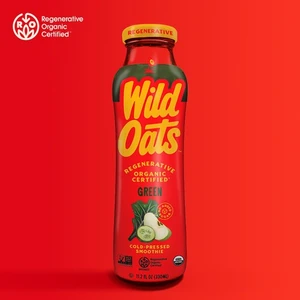
Apricot Juice - 11.2 oz
Wild Oats
$4.49
Below are the available bulk discount rates for each individual item when you purchase a certain amount
- Buy 2 - 5 and get 5% off
- Buy 6 - 11 and get 10% off
- Buy 12 or above and get 20% off
(No reviews yet)

Write a Review

Wild Oats
Apricot Juice - 11.2 oz
Real apricot juice — nothing watered down, nothing sweetened up. This 11.2 oz single-serve is pressed from Regenerative Organic Certified apricots, meaning the fruit was grown on soil that earns its keep: no synthetic pesticides, no monocropping, fair living wages for every worker in the supply chain. The flavor is what you get when you skip the concentrate and the cane sugar top-off — bright, tart, and genuinely fruit-forward.
- Drink it straight as a sharp morning ritual, mix it into salad dressings, or use it as a base for marinades and mocktails where real stone-fruit acidity matters.
- Carries Regenerative Organic Certified Bronze — a standard that layers USDA Organic soil requirements with Fair Trade social accountability and animal welfare benchmarks, audited by a third party.
- Certified USDA Organic, Non-GMO Project Verified, Vegan, Fairtrade, and Kosher — suitable for vegan, kosher, and organic-only households.
Most fruit juices on the shelf are built around concentrate, added sugar, and flavor packets engineered to taste like the fruit they replaced. This is not that.
Wild Oats Apricot Juice is single-ingredient — organic apricot juice, full stop. The 11.2 fl oz serving size is designed for a single occasion: one glass, one fruit, no dilution. The flavor profile reflects what apricots actually taste like when they're grown properly: bright acidity up front, moderate sweetness, and a slightly tannic finish that concentrate-based juices never deliver.
The sourcing story here is more verifiable than most. Regenerative Organic Certified Bronze is one of the most rigorous agricultural standards in the U.S. food system. It requires USDA Organic compliance as a floor (no synthetic pesticides, no herbicides, no chemical fertilizers, no GMOs), then layers on Fairtrade social accountability (fair living wages, safe conditions, worker opportunity) and animal welfare standards. Every claim on the label has been audited by a third-party certifier — not self-reported.
This juice is vegan, kosher (Orthodox Union), Non-GMO Project Verified, and USDA Organic. Store at room temperature until opened; refrigerate after opening and consume promptly.
Ingredients: Organic Apricot Juice.
Common Questions
How does this apricot juice compare to conventional apricot juice or nectar on the shelf?
Most commercial apricot products labeled 'juice' or 'nectar' are made from concentrate, meaning the fruit is juiced, water is evaporated to create a syrup for cheaper transport, and water is added back later — often alongside added sugars, natural flavors, or citric acid to compensate for flavor loss. This product contains one ingredient: organic apricot juice, never reconstituted from concentrate. That distinction matters for flavor because volatile aromatic compounds responsible for fresh apricot's characteristic floral brightness — including linalool and beta-ionone — degrade significantly during the concentration and reconstitution process. You're also getting the juice as it came from the fruit, with no dilution ratio adjustments that can quietly reduce nutrient density per fluid ounce.
What nutrients does apricot juice naturally contain and what do they do in the body?
Apricots are one of the more significant fruit sources of beta-carotene, the carotenoid precursor to vitamin A, which the body converts via the enzyme beta-carotene 15,15'-monooxygenase. Beta-carotene also functions as a direct antioxidant, quenching singlet oxygen radicals in tissues. Apricots provide potassium, which supports cellular fluid balance and normal muscle contraction through the sodium-potassium ATPase pump. They also contain chlorogenic acids, a class of polyphenols studied for their role in moderating postprandial blood glucose response by inhibiting glucose-6-phosphatase activity in the intestinal wall. The vitamin C present supports collagen synthesis by acting as a cofactor for prolyl hydroxylase, the enzyme that stabilizes collagen triple-helix structure.
What does Regenerative Organic Certified Bronze actually require, and how is it verified?
Regenerative Organic Certified (ROC) is administered by the Regenerative Organic Alliance and uses USDA Organic certification as a non-negotiable baseline — meaning no synthetic pesticides, herbicides, or chemical fertilizers are permitted at any level. Bronze tier, the entry tier, additionally requires Fairtrade or equivalent social accountability certification covering fair wages, safe working conditions, and worker empowerment, plus animal welfare standards aligned with Animal Welfare Approved or equivalent. Critically, ROC is not self-reported: farms and supply chains must be audited by accredited third-party certifiers, and the certification is time-limited with renewal audits required. This product also carries USDA Organic, Non-GMO Project Verified, Orthodox Union Kosher, and Certified Fairtrade independently — meaning each of those claims has been verified by a separate certifying body, not bundled under a single audit.
Is this juice suitable for vegan, kosher, or other specific dietary practices?
This juice carries an official Vegan certification, meaning it has been evaluated and confirmed to contain no animal-derived ingredients or processing aids — including fining agents like gelatin or isinglass sometimes used in juice clarification. It holds Orthodox Union (OU) Kosher certification, one of the most widely recognized kosher symbols globally, covering both ingredient sourcing and production facility standards. The single-ingredient formulation — organic apricot juice only — means there are no hidden additives, natural flavors derived from animal sources, or carrier solvents to evaluate. It is not, however, appropriate for ketogenic diets, as fruit juice is a concentrated source of naturally occurring sugars (primarily fructose and glucose) with minimal fiber, making it high in net carbohydrates relative to its volume.
How can this juice be used in cooking or as a recipe ingredient?
Apricot juice works as a braising liquid for pork tenderloin, lamb shoulder, or duck legs, where its natural acidity tenderizes protein and its moderate sugar content caramelizes into a glaze during reduction — typically reduce by half over medium heat before using as a finishing sauce. It substitutes for white wine in pan sauces at a 1:1 ratio, though you should reduce the added sweetener in the recipe by about 25% to account for the juice's natural sugars. In vinaigrettes, it replaces citrus juice or vinegar at roughly 2:1 (two parts apricot juice to one part vinegar) alongside a neutral oil and Dijon mustard. It also blends well into marinades for chicken or firm white fish — the chlorogenic acids and vitamin C both contribute mild enzymatic and acidic tenderizing effects. For baking, it can replace water or milk in quick bread and muffin recipes at 1:1, adding both moisture and a subtle stone-fruit note.
Why is the serving size 11.2 fl oz and is that the whole bottle?
The 11.2 fl oz format is a single-serve size — the entire bottle is one portion, designed to be consumed in one sitting rather than measured out from a larger container. This format is common for premium single-ingredient juices because it eliminates the oxidation and flavor degradation that occurs when a larger bottle is opened, partially consumed, and refrigerated for days. Once opened, juice begins oxidizing rapidly: vitamin C degrades within 24-48 hours of oxygen exposure, and volatile aromatic compounds responsible for fresh flavor dissipate within the same window. The single-serve format means you get the full nutritional and sensory profile of the juice at its peak, without managing a partially consumed bottle.
Does organic certification mean pesticides were not used on these apricots?
USDA Organic certification prohibits the use of synthetic pesticides and synthetic herbicides, but it does not mean zero pesticide use — it means only approved substances from the National List of Allowed and Prohibited Substances may be used, which includes certain naturally derived compounds like copper-based fungicides and sulfur. In practice, certified organic apricot production relies heavily on integrated pest management, beneficial insect populations, and physical barriers rather than chemical intervention. The additional Regenerative Organic Certified layer on this product adds soil health requirements — building organic matter, reducing tillage — which indirectly reduces pest pressure by supporting healthier plant immunity. Non-GMO Project Verified provides a separate audit confirming no genetically modified organisms are present in the product, which is redundant with USDA Organic on paper but represents an independent testing protocol that cross-checks the supply chain.
Wild Oats Apricot Juice is single-ingredient — organic apricot juice, full stop. The 11.2 fl oz serving size is designed for a single occasion: one glass, one fruit, no dilution. The flavor profile reflects what apricots actually taste like when they're grown properly: bright acidity up front, moderate sweetness, and a slightly tannic finish that concentrate-based juices never deliver.
The sourcing story here is more verifiable than most. Regenerative Organic Certified Bronze is one of the most rigorous agricultural standards in the U.S. food system. It requires USDA Organic compliance as a floor (no synthetic pesticides, no herbicides, no chemical fertilizers, no GMOs), then layers on Fairtrade social accountability (fair living wages, safe conditions, worker opportunity) and animal welfare standards. Every claim on the label has been audited by a third-party certifier — not self-reported.
This juice is vegan, kosher (Orthodox Union), Non-GMO Project Verified, and USDA Organic. Store at room temperature until opened; refrigerate after opening and consume promptly.
Ingredients: Organic Apricot Juice.
Common Questions
How does this apricot juice compare to conventional apricot juice or nectar on the shelf?
Most commercial apricot products labeled 'juice' or 'nectar' are made from concentrate, meaning the fruit is juiced, water is evaporated to create a syrup for cheaper transport, and water is added back later — often alongside added sugars, natural flavors, or citric acid to compensate for flavor loss. This product contains one ingredient: organic apricot juice, never reconstituted from concentrate. That distinction matters for flavor because volatile aromatic compounds responsible for fresh apricot's characteristic floral brightness — including linalool and beta-ionone — degrade significantly during the concentration and reconstitution process. You're also getting the juice as it came from the fruit, with no dilution ratio adjustments that can quietly reduce nutrient density per fluid ounce.
What nutrients does apricot juice naturally contain and what do they do in the body?
Apricots are one of the more significant fruit sources of beta-carotene, the carotenoid precursor to vitamin A, which the body converts via the enzyme beta-carotene 15,15'-monooxygenase. Beta-carotene also functions as a direct antioxidant, quenching singlet oxygen radicals in tissues. Apricots provide potassium, which supports cellular fluid balance and normal muscle contraction through the sodium-potassium ATPase pump. They also contain chlorogenic acids, a class of polyphenols studied for their role in moderating postprandial blood glucose response by inhibiting glucose-6-phosphatase activity in the intestinal wall. The vitamin C present supports collagen synthesis by acting as a cofactor for prolyl hydroxylase, the enzyme that stabilizes collagen triple-helix structure.
What does Regenerative Organic Certified Bronze actually require, and how is it verified?
Regenerative Organic Certified (ROC) is administered by the Regenerative Organic Alliance and uses USDA Organic certification as a non-negotiable baseline — meaning no synthetic pesticides, herbicides, or chemical fertilizers are permitted at any level. Bronze tier, the entry tier, additionally requires Fairtrade or equivalent social accountability certification covering fair wages, safe working conditions, and worker empowerment, plus animal welfare standards aligned with Animal Welfare Approved or equivalent. Critically, ROC is not self-reported: farms and supply chains must be audited by accredited third-party certifiers, and the certification is time-limited with renewal audits required. This product also carries USDA Organic, Non-GMO Project Verified, Orthodox Union Kosher, and Certified Fairtrade independently — meaning each of those claims has been verified by a separate certifying body, not bundled under a single audit.
Is this juice suitable for vegan, kosher, or other specific dietary practices?
This juice carries an official Vegan certification, meaning it has been evaluated and confirmed to contain no animal-derived ingredients or processing aids — including fining agents like gelatin or isinglass sometimes used in juice clarification. It holds Orthodox Union (OU) Kosher certification, one of the most widely recognized kosher symbols globally, covering both ingredient sourcing and production facility standards. The single-ingredient formulation — organic apricot juice only — means there are no hidden additives, natural flavors derived from animal sources, or carrier solvents to evaluate. It is not, however, appropriate for ketogenic diets, as fruit juice is a concentrated source of naturally occurring sugars (primarily fructose and glucose) with minimal fiber, making it high in net carbohydrates relative to its volume.
How can this juice be used in cooking or as a recipe ingredient?
Apricot juice works as a braising liquid for pork tenderloin, lamb shoulder, or duck legs, where its natural acidity tenderizes protein and its moderate sugar content caramelizes into a glaze during reduction — typically reduce by half over medium heat before using as a finishing sauce. It substitutes for white wine in pan sauces at a 1:1 ratio, though you should reduce the added sweetener in the recipe by about 25% to account for the juice's natural sugars. In vinaigrettes, it replaces citrus juice or vinegar at roughly 2:1 (two parts apricot juice to one part vinegar) alongside a neutral oil and Dijon mustard. It also blends well into marinades for chicken or firm white fish — the chlorogenic acids and vitamin C both contribute mild enzymatic and acidic tenderizing effects. For baking, it can replace water or milk in quick bread and muffin recipes at 1:1, adding both moisture and a subtle stone-fruit note.
Why is the serving size 11.2 fl oz and is that the whole bottle?
The 11.2 fl oz format is a single-serve size — the entire bottle is one portion, designed to be consumed in one sitting rather than measured out from a larger container. This format is common for premium single-ingredient juices because it eliminates the oxidation and flavor degradation that occurs when a larger bottle is opened, partially consumed, and refrigerated for days. Once opened, juice begins oxidizing rapidly: vitamin C degrades within 24-48 hours of oxygen exposure, and volatile aromatic compounds responsible for fresh flavor dissipate within the same window. The single-serve format means you get the full nutritional and sensory profile of the juice at its peak, without managing a partially consumed bottle.
Does organic certification mean pesticides were not used on these apricots?
USDA Organic certification prohibits the use of synthetic pesticides and synthetic herbicides, but it does not mean zero pesticide use — it means only approved substances from the National List of Allowed and Prohibited Substances may be used, which includes certain naturally derived compounds like copper-based fungicides and sulfur. In practice, certified organic apricot production relies heavily on integrated pest management, beneficial insect populations, and physical barriers rather than chemical intervention. The additional Regenerative Organic Certified layer on this product adds soil health requirements — building organic matter, reducing tillage — which indirectly reduces pest pressure by supporting healthier plant immunity. Non-GMO Project Verified provides a separate audit confirming no genetically modified organisms are present in the product, which is redundant with USDA Organic on paper but represents an independent testing protocol that cross-checks the supply chain.
- __Storage_Location:
- Dry
- __Volume:
- 500
- __badge:
- Regenerative
- __Owner:
- TCFarm