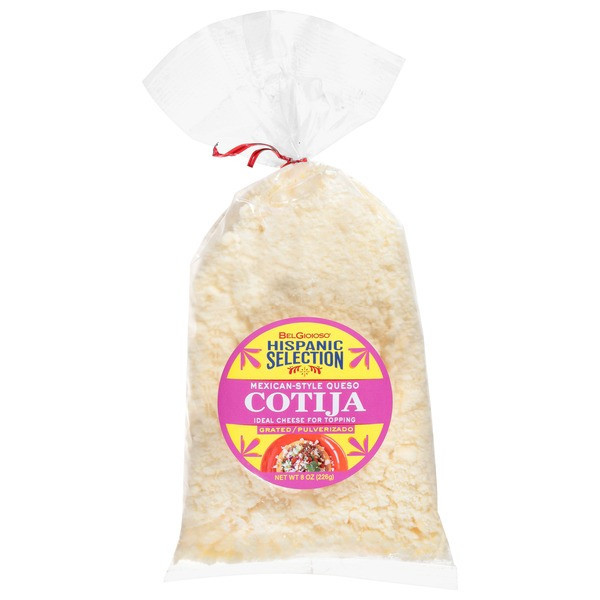
Grated Cotija Cheese - 8 oz
BelGioioso
$4.99
Below are the available bulk discount rates for each individual item when you purchase a certain amount
- Buy 2 - 5 and get 2% off
- Buy 6 - 11 and get 4% off
- Buy 12 or above and get 8% off
(No reviews yet)

Write a Review
BelGioioso
Grated Cotija Cheese - 8 oz
BelGioioso ages this Cotija the way cheesemakers in Michoacán have for generations: pressed firm, salted heavy, and dried until it turns dense and crumbly instead of sliceable — the profile that separates true Cotija from a soft, fresh Mexican cheese. It arrives already grated in a twist-tie bag, so it's ready to finish a dish the moment you open it — no block, no grater, no cutting board mess.
- Pre-grated for immediate use — scatter it over street corn, tacos, refried beans, or a Southwestern salad without pulling out a grater or a knife.
- Aged and dried rather than fresh, so it holds its crumble under heat instead of melting — the reason cooks use Cotija as a finishing garnish, not a melting cheese.
- A cow's milk cheese with no wheat-based ingredients, fitting naturally into gluten-free Mexican and Southwestern menus.
BelGioioso has built its reputation on staying faithful to time-honored cheesemaking recipes, and its authentic Cotija cheese carries that same discipline into a Mexican classic. This is a firm, aged cow's milk cheese - pressed, salted heavily, and dried until it becomes dense and crumbly rather than sliceable, the traditional profile of cheese named for the town of Cotija in Michoacan, Mexico, though this particular batch is crafted at BelGioioso's Wisconsin creamery using that same Old World method.
This bag arrives already grated in a twist-tie pouch, so the cheese is ready to scatter the moment you open it - no block to shred, no crumbs left on the cutting board. Because Cotija is aged rather than fresh, it holds its texture under heat: sprinkle it over a warm dish and it keeps its crumble instead of melting into the plate, which is exactly why it's traditionally used as a finishing garnish rather than a melting cheese.
Use it the way it's used across Mexican and Southwestern kitchens: finished over elote (Mexican street corn), stirred into refried or black beans, scattered over enchiladas, tacos, or a taco salad, or whisked into a corn chowder or tortilla soup just before serving. A little goes a long way - the aging process concentrates a sharp, salty flavor that a fresh Mexican cheese like queso fresco doesn't have. Being a naturally low-carb, high-fat aged cheese, it fits easily into keto, paleo, or carnivore-style eating, made simply from cultured milk, salt, and enzymes, with a touch of cellulose to prevent caking and natamycin, a natural mold inhibitor, to protect freshness.
Keep the bag sealed and refrigerated, and reclose the twist tie tightly after each use - because the cheese is already grated, it has more exposed surface area than a wedge, so a tight seal matters more to keep it from drying out or picking up other refrigerator odors.
Ingredients: Cultured Milk, Salt, Enzymes, Cellulose to Prevent Caking, Natamycin to Protect Flavor.
Common Questions
How does Cotija's nutrition compare to a conventional shredded cheese blend?
A typical 1-ounce serving of BelGioioso Cotija runs about 110 calories, 9 grams of fat, and 6 grams of protein, with roughly 320-350 milligrams of sodium — notably higher sodium than a mild cheddar or Monterey Jack blend, which usually sits closer to 170-200 milligrams per ounce. That higher sodium isn't a processing artifact; it's a direct result of the traditional Cotija method, where the curd is salted heavily before pressing and drying to draw out moisture and enable long aging without refrigeration in its original form. The tradeoff is flavor concentration: because so much water is removed, an ounce of Cotija delivers more dairy solids and flavor intensity than an ounce of a fresh, high-moisture shredded cheese, which is why recipes call for a tablespoon or two rather than a handful.
Why doesn't Cotija melt the way mozzarella or cheddar does?
Melting in cheese depends on moisture content and how intact the casein protein network remains after aging, and Cotija is built to resist both. During production the curd is pressed firmly and salted heavily, which pulls out whey and moisture, then the cheese is aged and dried further — the result is a low-moisture, high-protein-density structure where the casein matrix stays too tight and dehydrated to loosen into a liquid state under normal cooking heat. Softer melting cheeses like mozzarella retain 45-50% moisture and a looser protein structure; Cotija typically drops well below that, closer to the range of Parmesan. That's a feature, not a limitation — it's what lets you sprinkle it hot food and get a crumble that holds its shape instead of disappearing into a sauce.
Does Cotija fit a keto, paleo, or carnivore diet?
For keto, Cotija is a solid fit: at roughly 9 grams of fat, 6 grams of protein, and under 1 gram of carbohydrate per ounce, it delivers a fat-to-protein ratio that works well within most keto macro targets, especially as a finishing garnish rather than a main protein source. For paleo, dairy is a gray area depending on which version of the diet you follow — aged, cultured cheeses like Cotija are sometimes considered more acceptable than fresh milk because fermentation and aging reduce lactose content, but strict paleo protocols exclude dairy entirely. For carnivore, the same logic applies: some carnivore practitioners allow aged, low-lactose hard cheeses as an exception, but a purist carnivore approach excludes all dairy, so this is a personal-protocol call rather than a clear yes.
What can I use instead of Cotija if a recipe calls for a different cheese, or vice versa?
If you're out of Cotija, the closest substitute is a well-aged, salty grating cheese like Parmesan or Pecorino Romano — both are dry, hard, and salty enough to mimic the crumble-and-punch effect, though they lack Cotija's slightly tangier, more savory dairy note. Queso fresco is not a substitute despite being a Mexican cheese; it's fresh and mild rather than aged and salty, and it will melt or soften where Cotija would hold its texture. In the other direction, if a recipe calls for feta as a salty crumbled garnish — over roasted vegetables, salads, or grain bowls — Cotija works as a stand-in with a milder tang, though you may want to cut back slightly on any added salt in the recipe since Cotija itself is quite salty.
How can I verify that BelGioioso follows traditional Cotija production methods?
BelGioioso is a Wisconsin-based cheesemaker that has built its business specifically around recreating traditional Italian and international cheese styles using classic methods rather than industrial shortcuts, and the company publishes production details and cheese profiles for each variety on its own site, which you can cross-reference against descriptions of traditional Cotija from Michoacán, Mexico. Because this is a domestically produced version of a geographically named cheese rather than an imported product carrying a protected designation of origin, there's no official certification body verifying authenticity the way there might be for something like Parmigiano-Reggiano — so the best verification is checking the ingredient label for a short, recognizable list (milk, salt, cultures, enzymes) and confirming the texture and salt level match the dense, dry, crumbly traditional profile rather than a softer, blended imitation.
Why is this cheese pre-grated instead of sold as a block?
Cotija's dense, dry texture makes it genuinely difficult to grate at home compared to a softer cheese — its low moisture content means it crumbles unevenly and can dull a standard grater faster than a semi-firm cheese would. Selling it pre-grated in a sealed pouch solves that practical problem and gets you straight to the scatter-ready form the cheese is meant to be used in, since Cotija is essentially never eaten as a sliced or block cheese to begin with. The tradeoff is that grated cheese has more exposed surface area, so it's more prone to drying out or absorbing refrigerator odors than a wedge would be, which is why resealing the twist tie tightly after each use matters more here than it would for a block cheese wrapped in paper.
Is Cotija a good match for dishes beyond traditional Mexican cooking?
Yes — because Cotija's role is textural and flavor-concentrating rather than melting, it works anywhere you'd want a salty, savory crumble on top of a warm dish, not just in Mexican recipes. It's a reasonable stand-in wherever a recipe calls for crumbled feta or shaved Parmesan as a finishing touch: over roasted corn, grain bowls, baked sweet potatoes, or even a finishing sprinkle on soups like a corn chowder or a creamy vegetable soup. The main adjustment when substituting it into non-Mexican recipes is dialing back any additional added salt, since Cotija's heavy salting during production means a small amount goes further than most people expect.
This bag arrives already grated in a twist-tie pouch, so the cheese is ready to scatter the moment you open it - no block to shred, no crumbs left on the cutting board. Because Cotija is aged rather than fresh, it holds its texture under heat: sprinkle it over a warm dish and it keeps its crumble instead of melting into the plate, which is exactly why it's traditionally used as a finishing garnish rather than a melting cheese.
Use it the way it's used across Mexican and Southwestern kitchens: finished over elote (Mexican street corn), stirred into refried or black beans, scattered over enchiladas, tacos, or a taco salad, or whisked into a corn chowder or tortilla soup just before serving. A little goes a long way - the aging process concentrates a sharp, salty flavor that a fresh Mexican cheese like queso fresco doesn't have. Being a naturally low-carb, high-fat aged cheese, it fits easily into keto, paleo, or carnivore-style eating, made simply from cultured milk, salt, and enzymes, with a touch of cellulose to prevent caking and natamycin, a natural mold inhibitor, to protect freshness.
Keep the bag sealed and refrigerated, and reclose the twist tie tightly after each use - because the cheese is already grated, it has more exposed surface area than a wedge, so a tight seal matters more to keep it from drying out or picking up other refrigerator odors.
Ingredients: Cultured Milk, Salt, Enzymes, Cellulose to Prevent Caking, Natamycin to Protect Flavor.
Common Questions
How does Cotija's nutrition compare to a conventional shredded cheese blend?
A typical 1-ounce serving of BelGioioso Cotija runs about 110 calories, 9 grams of fat, and 6 grams of protein, with roughly 320-350 milligrams of sodium — notably higher sodium than a mild cheddar or Monterey Jack blend, which usually sits closer to 170-200 milligrams per ounce. That higher sodium isn't a processing artifact; it's a direct result of the traditional Cotija method, where the curd is salted heavily before pressing and drying to draw out moisture and enable long aging without refrigeration in its original form. The tradeoff is flavor concentration: because so much water is removed, an ounce of Cotija delivers more dairy solids and flavor intensity than an ounce of a fresh, high-moisture shredded cheese, which is why recipes call for a tablespoon or two rather than a handful.
Why doesn't Cotija melt the way mozzarella or cheddar does?
Melting in cheese depends on moisture content and how intact the casein protein network remains after aging, and Cotija is built to resist both. During production the curd is pressed firmly and salted heavily, which pulls out whey and moisture, then the cheese is aged and dried further — the result is a low-moisture, high-protein-density structure where the casein matrix stays too tight and dehydrated to loosen into a liquid state under normal cooking heat. Softer melting cheeses like mozzarella retain 45-50% moisture and a looser protein structure; Cotija typically drops well below that, closer to the range of Parmesan. That's a feature, not a limitation — it's what lets you sprinkle it hot food and get a crumble that holds its shape instead of disappearing into a sauce.
Does Cotija fit a keto, paleo, or carnivore diet?
For keto, Cotija is a solid fit: at roughly 9 grams of fat, 6 grams of protein, and under 1 gram of carbohydrate per ounce, it delivers a fat-to-protein ratio that works well within most keto macro targets, especially as a finishing garnish rather than a main protein source. For paleo, dairy is a gray area depending on which version of the diet you follow — aged, cultured cheeses like Cotija are sometimes considered more acceptable than fresh milk because fermentation and aging reduce lactose content, but strict paleo protocols exclude dairy entirely. For carnivore, the same logic applies: some carnivore practitioners allow aged, low-lactose hard cheeses as an exception, but a purist carnivore approach excludes all dairy, so this is a personal-protocol call rather than a clear yes.
What can I use instead of Cotija if a recipe calls for a different cheese, or vice versa?
If you're out of Cotija, the closest substitute is a well-aged, salty grating cheese like Parmesan or Pecorino Romano — both are dry, hard, and salty enough to mimic the crumble-and-punch effect, though they lack Cotija's slightly tangier, more savory dairy note. Queso fresco is not a substitute despite being a Mexican cheese; it's fresh and mild rather than aged and salty, and it will melt or soften where Cotija would hold its texture. In the other direction, if a recipe calls for feta as a salty crumbled garnish — over roasted vegetables, salads, or grain bowls — Cotija works as a stand-in with a milder tang, though you may want to cut back slightly on any added salt in the recipe since Cotija itself is quite salty.
How can I verify that BelGioioso follows traditional Cotija production methods?
BelGioioso is a Wisconsin-based cheesemaker that has built its business specifically around recreating traditional Italian and international cheese styles using classic methods rather than industrial shortcuts, and the company publishes production details and cheese profiles for each variety on its own site, which you can cross-reference against descriptions of traditional Cotija from Michoacán, Mexico. Because this is a domestically produced version of a geographically named cheese rather than an imported product carrying a protected designation of origin, there's no official certification body verifying authenticity the way there might be for something like Parmigiano-Reggiano — so the best verification is checking the ingredient label for a short, recognizable list (milk, salt, cultures, enzymes) and confirming the texture and salt level match the dense, dry, crumbly traditional profile rather than a softer, blended imitation.
Why is this cheese pre-grated instead of sold as a block?
Cotija's dense, dry texture makes it genuinely difficult to grate at home compared to a softer cheese — its low moisture content means it crumbles unevenly and can dull a standard grater faster than a semi-firm cheese would. Selling it pre-grated in a sealed pouch solves that practical problem and gets you straight to the scatter-ready form the cheese is meant to be used in, since Cotija is essentially never eaten as a sliced or block cheese to begin with. The tradeoff is that grated cheese has more exposed surface area, so it's more prone to drying out or absorbing refrigerator odors than a wedge would be, which is why resealing the twist tie tightly after each use matters more here than it would for a block cheese wrapped in paper.
Is Cotija a good match for dishes beyond traditional Mexican cooking?
Yes — because Cotija's role is textural and flavor-concentrating rather than melting, it works anywhere you'd want a salty, savory crumble on top of a warm dish, not just in Mexican recipes. It's a reasonable stand-in wherever a recipe calls for crumbled feta or shaved Parmesan as a finishing touch: over roasted corn, grain bowls, baked sweet potatoes, or even a finishing sprinkle on soups like a corn chowder or a creamy vegetable soup. The main adjustment when substituting it into non-Mexican recipes is dialing back any additional added salt, since Cotija's heavy salting during production means a small amount goes further than most people expect.
- __Storage_Location:
- Refrigerated
- __Volume:
- 1100
- __Owner:
- TCFarm
Related Products
-
-
-
Sale
-