
Three Cheese Mac & Cheese Bites - 8 oz
Feel Good Foods
$8.49
Below are the available bulk discount rates for each individual item when you purchase a certain amount
- Buy 2 - 3 and get 2% off
- Buy 4 - 8 and get 4% off
- Buy 9 or above and get 8% off
(No reviews yet)

Write a Review
Feel Good Foods
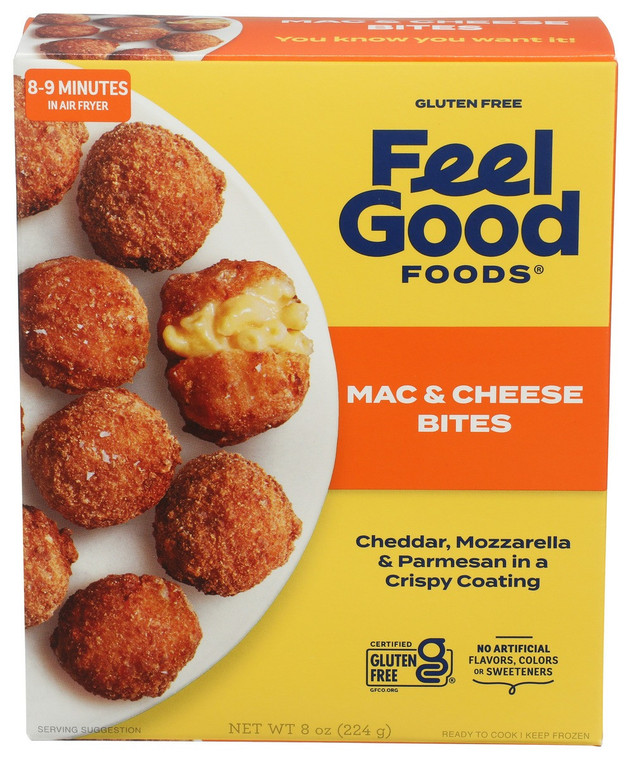
Three Cheese Mac & Cheese Bites - 8 oz
Real mac and cheese, made gluten-free without losing the crunch. Each bite starts with brown rice elbow macaroni tossed in a sauce built from actual cheddar, mozzarella, and parmesan — not cheese powder alone — then wrapped in a rice-flour breading engineered to fry up crisp and golden, never gummy or soft, the way most gluten-free breaded snacks tend to go.
- Sized for snacking, appetizer trays, lunchboxes, or a fast side dish straight from the freezer
- Cheese sauce built on a three-cheese blend of cheddar, mozzarella, and parmesan, breaded in a rice flour and tapioca starch crust for a genuinely crisp exterior
- Certified gluten-free — an indulgent comfort-food format built for shoppers who can't eat wheat-based breading
Feel Good Foods built its whole menu around a simple idea: comfort food shouldn't force a tradeoff between what tastes good and what you can actually eat. These Three Cheese Mac & Cheese Bites are their gluten-free, frozen appetizer answer to a fried mac-and-cheese ball — and the breading is the hard part they solved.
Inside each bite is brown rice elbow macaroni folded into a cheese sauce made from real cheddar, mozzarella, and parmesan (not just cheese flavoring), bound with a touch of cornstarch and mustard powder for depth. That filling is enrobed in a rice flour and tapioca starch breading seasoned with garlic, onion, and spices, then finished with a light coat of canola oil for the fry. The package arrives frozen and ready to cook straight from the bag — no thawing, no breading station required.
For the crispest result, follow the bake, air fry, or deep-fry instructions on the package — these bites are designed to come out crisp and golden using any of those methods. Pair with marinara, ranch, or a simple hot sauce dip for game day, or drop a few alongside a salad for a fast, gluten-free side dish on a weeknight.
Every ingredient is gluten-free by design — the breading uses rice flour and tapioca starch instead of wheat, and the macaroni is made from brown rice flour rather than semolina. They're vegetarian but not dairy-free or vegan, since the cheese sauce contains dairy and the macaroni contains egg, and the starch- and rice-based breading and macaroni mean these bites aren't a fit for keto, paleo, or carnivore eating plans. Keep them frozen at 0°F or below until you're ready to cook, and cook from frozen for the crispiest crust — thawing beforehand will make the breading soggy.
Ingredients: Breading (Rice Flour, Tapioca Starch, Water, Xanthan Gum, Cane Sugar, Yeast, Leavening [Sodium Acid Pyrophosphate, Baking Soda], Salt, Spices, Dehydrated Garlic, Dehydrated Onion), Macaroni (Water, Brown Rice Flour, Potato Starch, Tapioca Starch, Whole Egg, Egg White, Xanthan Gum, Salt), Cheese Sauce (Cheddar Cheese [Pasteurized Milk, Cheese Cultures, Salt, Enzymes], Milk, Mozzarella Cheese [Pasteurized Milk, Cheese Cultures, Salt, Enzymes], Parmesan Cheese [Pasteurized Milk, Cheese Cultures, Salt, Enzymes], Cheddar Cheese Powder [Pasteurized Milk, Salt, Cheese Culture, Enzymes], Corn Starch, Salt, Mustard Powder, Black Pepper, Carrot Juice Concentrate), Canola Oil.
Common Questions
How does the carb and gluten content compare to a conventional breaded mac and cheese bite?
A typical wheat-breaded mac and cheese bite runs 15-18 grams of carbs per serving from semolina pasta and wheat flour breading, plus 2-3 grams of gluten protein per 100 grams of breading. This version swaps semolina for brown rice flour in the macaroni and uses rice flour and tapioca starch in the breading, which lands in a similar carb range per bite but with zero gluten. The starch blend behaves differently in the fryer or oven than wheat flour does, which is why the breading recipe includes xanthan gum and a two-part leavening system (sodium acid pyrophosphate and baking soda) to mimic the structure gluten normally provides. Calorie and fat counts are comparable to conventional versions since both use a fried or oil-coated exterior.
What does xanthan gum actually do in a gluten-free recipe like this one?
Xanthan gum is a fermentation-derived polysaccharide that acts as a stand-in for gluten's binding and elasticity function. Wheat flour relies on gluten proteins (gliadin and glutenin) to trap air and hold a dough together during mixing and cooking; rice flour and tapioca starch have no equivalent protein structure on their own. Xanthan gum forms a viscous network when hydrated that holds the breading together during freezing, thawing resistance, and high-heat cooking so it doesn't crumble or separate from the filling. It's used in small amounts, appearing in both the breading and the macaroni in this product for that reason.
Do these fit a keto, paleo, or carnivore diet?
No, this product doesn't fit any of those three diets. The breading and macaroni are both starch-based (rice flour, tapioca starch, potato starch), which puts total carbs high enough per serving to conflict with keto's typical under-20-to-50-gram daily carb target. Paleo excludes grains and legumes entirely, and rice flour is a grain-derived ingredient, so it's out on that front too. Carnivore allows only animal products, and this is a vegetarian item built around pasta and breading, so it doesn't qualify there either. It is a solid option for someone who needs gluten-free specifically but isn't restricting carbs or grains generally.
What dishes can I use these in besides serving them as a straight appetizer?
They work well chopped and folded into a baked casserole in place of plain elbow macaroni if you want extra cheese pull and a crisp topping layer. Cut in half and served over a bowl of chili, they function like a gluten-free version of Frito pie or a mac-and-cheese chili bowl. They also hold up as a burger or sandwich topper, cooked whole and stacked next to the patty for a comfort-food build. Because they're pre-fried and only need reheating, they crisp back up fine in an air fryer at 375°F for about 4-5 minutes if you're repurposing them a day later rather than cooking from fully frozen.
What does the gluten-free certification actually verify, and how can I confirm it myself?
A gluten-free certification means the finished product has been tested to contain less than 20 parts per million of gluten, which is the FDA's legal threshold for a 'gluten-free' label claim in the US. This requires the manufacturer to control not just the ingredient list but also cross-contact risk on shared equipment, since rice flour and tapioca starch lines often run alongside wheat-based products in co-packing facilities. You can verify the claim by checking the ingredient panel for any hidden wheat-derived additives (there are none listed here — the starches are rice, tapioca, potato, and corn) and by looking for a recognized gluten-free certification mark on the package rather than just a manufacturer's own label claim. If a product only says 'gluten-free' without a third-party certifying body listed, it's a self-declared claim rather than an independently verified one.
Is the cheese in the filling real cheese or a cheese-flavored substitute?
It's real cheese. The cheese sauce lists cheddar, mozzarella, and parmesan as cultured, enzyme-set cheeses made from pasteurized milk, not a vegetable-oil-based cheese analog or a purely flavored powder blend. Cheddar cheese powder is also included for concentrated flavor, but it's listed as being made from pasteurized milk, salt, cheese culture, and enzymes, meaning it's dehydrated real cheese rather than an artificial flavoring. Corn starch and milk are used to thicken and stabilize the sauce so it stays creamy rather than separating during freezing and reheating, and mustard powder and black pepper are added for background flavor depth rather than as fillers.
Why does the package say to cook from frozen instead of thawing first?
The breading is engineered to crisp through a rapid moisture-loss process when it hits high heat directly from a frozen state — the rice flour and tapioca starch exterior sets fast enough to seal in the cheese sauce before it has a chance to leak out. If you thaw first, the breading absorbs ambient moisture from the softening cheese filling underneath, and that moisture turns the starch-based crust soft and gummy instead of crisp during cooking. This is more pronounced with rice-and-tapioca breading than with wheat flour breading, since wheat's gluten network is somewhat more forgiving of pre-absorbed moisture. Cooking from frozen at the stated temperatures (425°F baked, 400°F air-fried, or 350°F deep-fried) is what gets the crust texture the product is designed around.
Inside each bite is brown rice elbow macaroni folded into a cheese sauce made from real cheddar, mozzarella, and parmesan (not just cheese flavoring), bound with a touch of cornstarch and mustard powder for depth. That filling is enrobed in a rice flour and tapioca starch breading seasoned with garlic, onion, and spices, then finished with a light coat of canola oil for the fry. The package arrives frozen and ready to cook straight from the bag — no thawing, no breading station required.
For the crispest result, follow the bake, air fry, or deep-fry instructions on the package — these bites are designed to come out crisp and golden using any of those methods. Pair with marinara, ranch, or a simple hot sauce dip for game day, or drop a few alongside a salad for a fast, gluten-free side dish on a weeknight.
Every ingredient is gluten-free by design — the breading uses rice flour and tapioca starch instead of wheat, and the macaroni is made from brown rice flour rather than semolina. They're vegetarian but not dairy-free or vegan, since the cheese sauce contains dairy and the macaroni contains egg, and the starch- and rice-based breading and macaroni mean these bites aren't a fit for keto, paleo, or carnivore eating plans. Keep them frozen at 0°F or below until you're ready to cook, and cook from frozen for the crispiest crust — thawing beforehand will make the breading soggy.
Ingredients: Breading (Rice Flour, Tapioca Starch, Water, Xanthan Gum, Cane Sugar, Yeast, Leavening [Sodium Acid Pyrophosphate, Baking Soda], Salt, Spices, Dehydrated Garlic, Dehydrated Onion), Macaroni (Water, Brown Rice Flour, Potato Starch, Tapioca Starch, Whole Egg, Egg White, Xanthan Gum, Salt), Cheese Sauce (Cheddar Cheese [Pasteurized Milk, Cheese Cultures, Salt, Enzymes], Milk, Mozzarella Cheese [Pasteurized Milk, Cheese Cultures, Salt, Enzymes], Parmesan Cheese [Pasteurized Milk, Cheese Cultures, Salt, Enzymes], Cheddar Cheese Powder [Pasteurized Milk, Salt, Cheese Culture, Enzymes], Corn Starch, Salt, Mustard Powder, Black Pepper, Carrot Juice Concentrate), Canola Oil.
Common Questions
How does the carb and gluten content compare to a conventional breaded mac and cheese bite?
A typical wheat-breaded mac and cheese bite runs 15-18 grams of carbs per serving from semolina pasta and wheat flour breading, plus 2-3 grams of gluten protein per 100 grams of breading. This version swaps semolina for brown rice flour in the macaroni and uses rice flour and tapioca starch in the breading, which lands in a similar carb range per bite but with zero gluten. The starch blend behaves differently in the fryer or oven than wheat flour does, which is why the breading recipe includes xanthan gum and a two-part leavening system (sodium acid pyrophosphate and baking soda) to mimic the structure gluten normally provides. Calorie and fat counts are comparable to conventional versions since both use a fried or oil-coated exterior.
What does xanthan gum actually do in a gluten-free recipe like this one?
Xanthan gum is a fermentation-derived polysaccharide that acts as a stand-in for gluten's binding and elasticity function. Wheat flour relies on gluten proteins (gliadin and glutenin) to trap air and hold a dough together during mixing and cooking; rice flour and tapioca starch have no equivalent protein structure on their own. Xanthan gum forms a viscous network when hydrated that holds the breading together during freezing, thawing resistance, and high-heat cooking so it doesn't crumble or separate from the filling. It's used in small amounts, appearing in both the breading and the macaroni in this product for that reason.
Do these fit a keto, paleo, or carnivore diet?
No, this product doesn't fit any of those three diets. The breading and macaroni are both starch-based (rice flour, tapioca starch, potato starch), which puts total carbs high enough per serving to conflict with keto's typical under-20-to-50-gram daily carb target. Paleo excludes grains and legumes entirely, and rice flour is a grain-derived ingredient, so it's out on that front too. Carnivore allows only animal products, and this is a vegetarian item built around pasta and breading, so it doesn't qualify there either. It is a solid option for someone who needs gluten-free specifically but isn't restricting carbs or grains generally.
What dishes can I use these in besides serving them as a straight appetizer?
They work well chopped and folded into a baked casserole in place of plain elbow macaroni if you want extra cheese pull and a crisp topping layer. Cut in half and served over a bowl of chili, they function like a gluten-free version of Frito pie or a mac-and-cheese chili bowl. They also hold up as a burger or sandwich topper, cooked whole and stacked next to the patty for a comfort-food build. Because they're pre-fried and only need reheating, they crisp back up fine in an air fryer at 375°F for about 4-5 minutes if you're repurposing them a day later rather than cooking from fully frozen.
What does the gluten-free certification actually verify, and how can I confirm it myself?
A gluten-free certification means the finished product has been tested to contain less than 20 parts per million of gluten, which is the FDA's legal threshold for a 'gluten-free' label claim in the US. This requires the manufacturer to control not just the ingredient list but also cross-contact risk on shared equipment, since rice flour and tapioca starch lines often run alongside wheat-based products in co-packing facilities. You can verify the claim by checking the ingredient panel for any hidden wheat-derived additives (there are none listed here — the starches are rice, tapioca, potato, and corn) and by looking for a recognized gluten-free certification mark on the package rather than just a manufacturer's own label claim. If a product only says 'gluten-free' without a third-party certifying body listed, it's a self-declared claim rather than an independently verified one.
Is the cheese in the filling real cheese or a cheese-flavored substitute?
It's real cheese. The cheese sauce lists cheddar, mozzarella, and parmesan as cultured, enzyme-set cheeses made from pasteurized milk, not a vegetable-oil-based cheese analog or a purely flavored powder blend. Cheddar cheese powder is also included for concentrated flavor, but it's listed as being made from pasteurized milk, salt, cheese culture, and enzymes, meaning it's dehydrated real cheese rather than an artificial flavoring. Corn starch and milk are used to thicken and stabilize the sauce so it stays creamy rather than separating during freezing and reheating, and mustard powder and black pepper are added for background flavor depth rather than as fillers.
Why does the package say to cook from frozen instead of thawing first?
The breading is engineered to crisp through a rapid moisture-loss process when it hits high heat directly from a frozen state — the rice flour and tapioca starch exterior sets fast enough to seal in the cheese sauce before it has a chance to leak out. If you thaw first, the breading absorbs ambient moisture from the softening cheese filling underneath, and that moisture turns the starch-based crust soft and gummy instead of crisp during cooking. This is more pronounced with rice-and-tapioca breading than with wheat flour breading, since wheat's gluten network is somewhat more forgiving of pre-absorbed moisture. Cooking from frozen at the stated temperatures (425°F baked, 400°F air-fried, or 350°F deep-fried) is what gets the crust texture the product is designed around.
- __Storage_Location:
- Frozen
- __Volume:
- 800
- __Owner:
- TCFarm
- __badge:
- Gluten-Free
Related Products
-
-
Sale
-
-