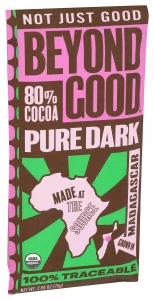
85% Dark Chocolate Sea Salt Bar - 2.64 oz
Beyond Good
$4.89
Below are the available bulk discount rates for each individual item when you purchase a certain amount
- Buy 2 - 71 and get 2% off
- Buy 72 - 143 and get 4% off
- Buy 144 or above and get 8% off
Beyond Good doesn't ship raw cocoa beans overseas for someone else to turn into chocolate. This Uganda-grown cocoa is processed at Beyond Good's own factory in Africa, close to origin, so it's turned into chocolate at peak freshness instead of after weeks in a shipping container bound for a distant industrial processor. That single decision — Made at the Source — is why this 85% bar tastes like the fruit it actually came from, not a commodity blend.
- An 85% dark chocolate bar finished with flaky fleur de sel, built for anyone who wants cocoa's real, fruit-forward flavor with a clean salt finish — not sweetness dressed up as chocolate.
- Direct Trade Certified cocoa grown and fermented in Uganda, tracked bean-to-bar through a supply chain you can scan and see yourself — no anonymous blending with beans from unnamed regions.
- Vegan, dairy-free, and gluten-free by ingredient list, with certified organic cocoa that's grown to support reforestation and biodiversity around the farms it comes from.
Most dark chocolate on a grocery shelf is a blend — beans from several countries, mixed and processed at a facility that never touches the farms that grew them. Beyond Good runs the opposite model: this bar's Uganda-grown cocoa is processed into chocolate at Beyond Good's own factory in Africa, close to origin, so the beans avoid the flavor-flattening delay of long-distance shipping to an outside industrial processor.
This 85% dark chocolate bar is finished with fleur de sel, packaged at 2.64 oz (75g). The cocoa is certified organic and Direct Trade Certified, meaning Beyond Good has verified — and published — exactly which farms and cooperatives in Uganda the beans came from. The brand's supply chain is scannable on the package, not a marketing claim you have to take on faith.
At 85%, expect a bar that leads with cocoa's actual flavor — fruit, earth, a little bitterness — rather than sugar. The fleur de sel sharpens that flavor rather than masking it, so it works well broken into small pieces alongside coffee or a bold red wine, or snapped into a square as an afternoon reset instead of a sugar-heavy snack.
Suitable for vegan, dairy-free, and gluten-free diets based on the ingredient list below. While not formally certified keto or paleo, its high cocoa content and minimal cane sugar make it a bar many low-carb and paleo-minded eaters enjoy in moderation. Store in a cool, dry place away from direct sunlight; no refrigeration needed.
Ingredients: Cocoa Beans, Cane Sugar, Cocoa Butter, and Fleur De Sel.
Common Questions
How does this 85% bar compare nutritionally to a typical supermarket dark chocolate bar?
A standard 45% cacao dark chocolate bar usually runs about 24 grams of sugar per 100 grams, with cocoa solids making up less than half the bar by weight. This 85% bar flips that ratio: cocoa beans and cocoa butter are the first two ingredients, cane sugar is third, and sugar content drops to roughly 14-17 grams per 100 grams depending on the batch. In practical terms, a 40-gram serving of this bar has about 5-6 grams of sugar versus 10+ grams in a 45% bar of the same size, while delivering more cocoa flavanols and fiber per bite.
What actually happens chemically that gives dark chocolate its health reputation?
Cocoa beans contain flavanols, primarily epicatechin and catechin, which are polyphenol compounds shown in clinical research to support nitric oxide production in blood vessel walls. A widely cited Cochrane review (Hooper et al., 2012) found that higher flavanol intake was associated with measurable improvements in flow-mediated dilation, a marker of vascular function. The catch is that flavanol content drops sharply with alkalizing (Dutch processing) and with lower cocoa percentages, so an 85% bar made without alkalization retains substantially more of these compounds than a 45% milk-forward bar.
Does this fit into a keto, paleo, or low-sugar diet plan?
For keto, yes with attention to portion: a 20-gram serving (about 5 small pieces) typically carries around 5-6 grams of net carbs, which fits comfortably within a 20-25 gram daily carb budget. For strict paleo, the cane sugar technically disqualifies it, though many paleo-adjacent eaters treat high-percentage dark chocolate as an acceptable occasional food since sugar is the fourth ingredient by weight, not the first. It's fully vegan, dairy-free, and gluten-free based on the ingredient list, so it works for those restrictions without any substitution needed.
What dishes work well with this bar besides eating it straight?
Chop it and fold it into mole poblano or a chili recipe, where the fleur de sel and 85% intensity hold up against cumin, chile, and slow-cooked meat without disappearing. It also works melted into a ganache for tarts, or grated over a chocolate-crusted pork tenderloin as a finishing crust before searing. Because it's unsweetened relative to milk chocolate, recipes calling for semisweet or bittersweet baking chocolate may need an extra tablespoon or two of sugar to hit the intended sweetness level.
What does Direct Trade Certified actually verify, and how can I check it myself?
Direct Trade Certified means Beyond Good has documented and published the specific farms and cooperatives that supplied the cocoa, rather than sourcing through anonymous commodity trading channels. This is distinct from Fair Trade certification, which sets minimum price floors but doesn't require naming individual farms. The packaging includes a scannable code that links to the sourcing record, so the traceability claim is checkable rather than a statement you have to take at face value.
What does Made at the Source mean for how this chocolate tastes?
It means the entire process — roasting, grinding, conching, and bar-forming — happens in Uganda, close to the farms where the cocoa was grown, instead of shipping raw beans overseas to a separate processing facility. Cocoa beans start losing volatile aromatic compounds once fermented and dried, and long transit combined with reprocessing at a distant facility tends to flatten those notes before the bar is ever made. Processing near the farm shortens that window, which is part of why this bar reads as fruitier and more complex than a bar made from beans that traveled for weeks before reaching a factory.
This 85% dark chocolate bar is finished with fleur de sel, packaged at 2.64 oz (75g). The cocoa is certified organic and Direct Trade Certified, meaning Beyond Good has verified — and published — exactly which farms and cooperatives in Uganda the beans came from. The brand's supply chain is scannable on the package, not a marketing claim you have to take on faith.
At 85%, expect a bar that leads with cocoa's actual flavor — fruit, earth, a little bitterness — rather than sugar. The fleur de sel sharpens that flavor rather than masking it, so it works well broken into small pieces alongside coffee or a bold red wine, or snapped into a square as an afternoon reset instead of a sugar-heavy snack.
Suitable for vegan, dairy-free, and gluten-free diets based on the ingredient list below. While not formally certified keto or paleo, its high cocoa content and minimal cane sugar make it a bar many low-carb and paleo-minded eaters enjoy in moderation. Store in a cool, dry place away from direct sunlight; no refrigeration needed.
Ingredients: Cocoa Beans, Cane Sugar, Cocoa Butter, and Fleur De Sel.
Common Questions
How does this 85% bar compare nutritionally to a typical supermarket dark chocolate bar?
A standard 45% cacao dark chocolate bar usually runs about 24 grams of sugar per 100 grams, with cocoa solids making up less than half the bar by weight. This 85% bar flips that ratio: cocoa beans and cocoa butter are the first two ingredients, cane sugar is third, and sugar content drops to roughly 14-17 grams per 100 grams depending on the batch. In practical terms, a 40-gram serving of this bar has about 5-6 grams of sugar versus 10+ grams in a 45% bar of the same size, while delivering more cocoa flavanols and fiber per bite.
What actually happens chemically that gives dark chocolate its health reputation?
Cocoa beans contain flavanols, primarily epicatechin and catechin, which are polyphenol compounds shown in clinical research to support nitric oxide production in blood vessel walls. A widely cited Cochrane review (Hooper et al., 2012) found that higher flavanol intake was associated with measurable improvements in flow-mediated dilation, a marker of vascular function. The catch is that flavanol content drops sharply with alkalizing (Dutch processing) and with lower cocoa percentages, so an 85% bar made without alkalization retains substantially more of these compounds than a 45% milk-forward bar.
Does this fit into a keto, paleo, or low-sugar diet plan?
For keto, yes with attention to portion: a 20-gram serving (about 5 small pieces) typically carries around 5-6 grams of net carbs, which fits comfortably within a 20-25 gram daily carb budget. For strict paleo, the cane sugar technically disqualifies it, though many paleo-adjacent eaters treat high-percentage dark chocolate as an acceptable occasional food since sugar is the fourth ingredient by weight, not the first. It's fully vegan, dairy-free, and gluten-free based on the ingredient list, so it works for those restrictions without any substitution needed.
What dishes work well with this bar besides eating it straight?
Chop it and fold it into mole poblano or a chili recipe, where the fleur de sel and 85% intensity hold up against cumin, chile, and slow-cooked meat without disappearing. It also works melted into a ganache for tarts, or grated over a chocolate-crusted pork tenderloin as a finishing crust before searing. Because it's unsweetened relative to milk chocolate, recipes calling for semisweet or bittersweet baking chocolate may need an extra tablespoon or two of sugar to hit the intended sweetness level.
What does Direct Trade Certified actually verify, and how can I check it myself?
Direct Trade Certified means Beyond Good has documented and published the specific farms and cooperatives that supplied the cocoa, rather than sourcing through anonymous commodity trading channels. This is distinct from Fair Trade certification, which sets minimum price floors but doesn't require naming individual farms. The packaging includes a scannable code that links to the sourcing record, so the traceability claim is checkable rather than a statement you have to take at face value.
What does Made at the Source mean for how this chocolate tastes?
It means the entire process — roasting, grinding, conching, and bar-forming — happens in Uganda, close to the farms where the cocoa was grown, instead of shipping raw beans overseas to a separate processing facility. Cocoa beans start losing volatile aromatic compounds once fermented and dried, and long transit combined with reprocessing at a distant facility tends to flatten those notes before the bar is ever made. Processing near the farm shortens that window, which is part of why this bar reads as fruitier and more complex than a bar made from beans that traveled for weeks before reaching a factory.
- __Storage_Location:
- Dry
- __Volume:
- 119
- __Owner:
- TCFarm
- __badge:
- Organic