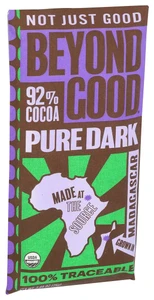
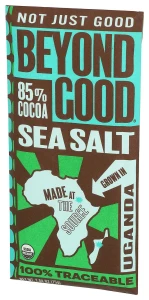
Beyond Good doesn't buy beans off a commodity market and process them an ocean away. They built a bean-to-bar factory in Madagascar, the country their cocoa comes from, so the people who grow it are also the ones who turn it into chocolate — a rare structure in an industry where over 90% of cocoa's value is typically added outside the countries that grow it.
This single-origin dark chocolate bar is cast from single-origin Madagascar cocoa at 80% cocoa content, in a 2.64 oz (75g) bar. At 80%, sugar takes a back seat — the bar leans into the cocoa's own acidity and tannin rather than sweetness, which is where Madagascar's signature red-fruit character (raspberry, cherry, tamarind notes depending on the harvest) comes through most clearly. Production runs are limited batches rather than continuous mass output, which keeps the flavor tied to a specific harvest rather than blended flat across origins.
Beyond Good's own tasting note: place a piece in your mouth, let it slow-melt rather than chewing it like a snack, and search your back teeth for the fruit notes as it dissolves — Madagascar cocoa is known for holding a distinct flavor profile that a fast bite skips past. The bar also works broken into chunks for baking where a fruit-forward dark chocolate note matters, such as brownies or a dark ganache.
Suitable for vegan and dairy-free diets; because it's sweetened with cane sugar, it doesn't fit strict keto or paleo plans, though the short, recognizable ingredient list keeps it far cleaner than typical mass-market chocolate. Store in a cool, dry place away from direct sunlight and heat; chocolate can bloom (a harmless white surface film) if exposed to temperature swings, but flavor is unaffected.
Ingredients: Cocoa Beans, Cane Sugar, Cocoa Butter, and Sunflower Lecithin (Emulsifier).
Common Questions
How does this compare to a typical mass-market dark chocolate bar?
Most dark chocolate on grocery shelves runs 60-70% cocoa and blends beans from several countries to keep flavor consistent and cost low, which usually pushes sugar content up toward 30% of the bar's weight. This bar sits at 80% cocoa from a single origin, so sugar is closer to 20% of the formula, meaning less sweetness and more of the bean's own acidity and tannin coming through. The bigger structural difference is where the value gets created: across the cocoa industry, an estimated 90%+ of the final value of a chocolate bar is typically added after the beans leave the growing country, through processing, branding, and retail markup done elsewhere. Here, the bean-to-bar conversion happens inside Madagascar itself, so a larger share of that value stays with the origin country rather than being captured downstream.
What actually causes the fruity, red-berry flavor in this chocolate?
That flavor comes from naturally occurring compounds in the cocoa bean itself — mainly polyphenols like catechin, epicatechin, and procyanidins, along with organic acids formed during fermentation of the beans. Madagascar cocoa is genetically and agriculturally distinct enough that these compounds express as raspberry, cherry, or tamarind-like notes rather than the flatter, more uniform taste you get from blended commodity cocoa. At 80% cocoa content, there's less sugar to mask these compounds, so the tannin and acidity read more clearly on the palate, especially in the back of the mouth as the chocolate slow-melts. Sunflower lecithin is the only added ingredient beyond cocoa and sugar, used at a very small percentage purely to keep the cocoa butter and solids from separating — it doesn't affect flavor.
Does this fit a keto or paleo diet?
For keto, portion size matters: an 80% dark chocolate bar like this generally runs somewhere around 5-6 grams of net carbs per 20-25 gram piece (roughly a quarter of the 75g bar), which is low enough to fit most daily carb budgets in small amounts, unlike milk chocolate or lower-percentage dark chocolate that carries two to three times the sugar. For paleo, the ingredient list is short and free of dairy, soy, or artificial additives, though strict paleo purists sometimes exclude cane sugar entirely — this bar does contain it, just in a smaller proportion than typical chocolate. It's not suitable for carnivore diets since it's plant-based with no animal-derived ingredients. It is fully vegan and dairy-free by ingredient list.
Can I use this for baking, and does it need any adjustment?
Yes — it works well broken into chunks for brownies, dark ganache, mole sauce, or as a mix-in for cookies where you want a pronounced dark cocoa note rather than sweetness. Because it's 80% cocoa rather than the 60-70% most baking chocolate recipes assume, you may want to add a tablespoon or two of extra sugar to the recipe if you're substituting it 1:1 by weight, since the bar itself is noticeably less sweet. For ganache, use the same ratio of chocolate to cream you'd normally use, but taste before adding sweetener since the fruit-forward acidity can read differently once heated. It melts the same way any high-cocoa-butter chocolate does — gently, over low heat or in short microwave bursts, to avoid seizing.
How can I verify the sourcing and certification claims on this bar?
The bar carries organic certification from a recognized certifying body, Non-GMO verification, and kosher certification, each of which involves third-party audits rather than self-reporting by the brand. The '100% traceable' claim refers to the fact that beans are processed at the company's own factory in Madagascar rather than sold through a commodity exchange, which means each batch can be traced back to the harvest and region it came from instead of being blended anonymously with cocoa from other countries. Because production runs are limited batches tied to specific harvests, you're not looking at a single unchanging recipe blended for year-round consistency — flavor can shift slightly batch to batch, which is itself a signal that the beans aren't being homogenized. Certification logos and traceability claims like these are things you can typically cross-check against the certifying body's public database if you want to confirm a specific batch.
What does 'Made at the Source' actually mean for this product?
It means the cocoa beans are fermented, dried, roasted, ground, and turned into finished chocolate bars at a factory built in Madagascar, the same country where the beans are grown — rather than being shipped raw to Europe or North America for processing, which is the standard model for most chocolate brands. This structure is uncommon in the industry specifically because processing infrastructure is expensive to build in cocoa-growing regions, so most companies find it cheaper to import raw beans and process them near their end market. Keeping processing at origin also means less time between harvest and roasting, which can help preserve the specific flavor compounds tied to that harvest rather than losing nuance over a long shipping and storage period. It's the mechanism behind both the traceability claim and the batch-specific flavor variation mentioned on the label.