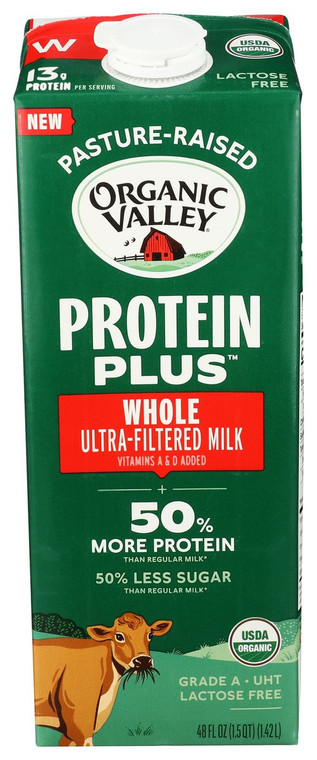
Organic Valley started in 1988 when a small group of Wisconsin family farmers decided organic dairy needed farmer-owners, not just farmer-suppliers. Today that cooperative is more than 1,600 small family farms strong across the U.S., and this Protein Plus Whole Milk is what happens when that same pasture-raised, USDA Certified Organic milk goes through a modern ultra-filtration process instead of a marketing department.
The filtration concentrates the milk's naturally occurring protein and pulls out excess lactose and sugar, then lactase enzyme is added to break down what's left - so this lactose-free, high-protein organic whole milk delivers more protein and less sugar than the milk in a regular carton, without any artificial protein isolates or flavor enhancers added to get there. Vitamins A and D are added, standard practice for fortified milk.
Nutritionally, this whole milk carries 13g of protein per serving - 10% more of the Daily Reference Value than the 8g in regular whole milk - and just 6g of sugar per serving, half of the 12g typical whole milk carries. It still comes from cows that graze organic pasture at least 120 days during the grazing season, have daily outdoor access, and are raised without antibiotics, synthetic pesticides, GMOs, or artificial growth hormones like rBST, all verified by third-party inspectors every year.
Drink it cold, pour it over cereal, blend it into a smoothie, or use it in coffee where you want the protein bump without the extra sugar. Because the lactase enzyme is already doing the work of breaking down lactose, most people who normally avoid milk can drink this one without the usual discomfort. As a dairy product with naturally occurring lactose sugars, it can fit a primal or general low-processed eating style but isn't suitable for strict keto, paleo, or carnivore diets that exclude dairy sugars entirely.
USDA Certified Organic, Kosher, and suitable for anyone managing lactose sensitivity while still wanting real dairy protein. Keep refrigerated at all times and consume by the date on the carton for best flavor.
Ingredients: Organic Ultra-Filtered Grade A Milk, Lactase Enzyme, Vitamin A Palmitate, and Vitamin D3.
Common Questions
How does this milk actually compare to a regular carton of whole milk, nutritionally?
Per 8-ounce serving, this Protein Plus Whole Milk has 13 grams of protein versus roughly 8 grams in conventional whole milk, and 6 grams of sugar versus roughly 12 grams. Total calories and fat content stay close to a standard whole milk since nothing is stripped from the fat side of the equation, only the lactose and excess water are concentrated out. The protein increase comes from ultra-filtration concentrating the milk's naturally occurring casein and whey, not from added protein isolates or powders. So you're getting about 60% more protein and half the sugar for a similar calorie count as a regular carton.
What is ultra-filtration and how does it change the milk without additives?
Ultra-filtration passes milk through a membrane with pores fine enough to hold back protein molecules (casein and whey) while letting water, lactose, and some minerals pass through. This naturally concentrates protein content per serving without adding whey protein concentrate, milk protein isolate, or any synthetic thickener. Lactase enzyme is then added afterward to break down the remaining lactose into glucose and galactose, which is why the milk tastes slightly sweeter despite carrying less total sugar. The result is a compositional change through physical filtration and enzymatic action, not a formulation built in a lab.
Does this fit a keto, paleo, or low-carb eating plan?
At 6 grams of sugar per 8-ounce serving, this milk carries less carbohydrate load than conventional milk, but it is not a zero-carb or ketogenic food since dairy sugar (even reduced) still counts toward daily carb totals on a strict keto protocol. Paleo followers who include grass-based dairy will find this fits reasonably well given the pasture-based, minimally processed profile, though strict paleo definitions often exclude dairy altogether. It does not fit carnivore or zero-carb diets that eliminate lactose-containing dairy entirely. For moderate low-carb approaches or those simply trying to cut added sugar while keeping dairy protein, the 6g-sugar, 13g-protein profile is a meaningfully better fit than standard whole milk.
Can I substitute this for regular milk in recipes, and does anything change in cooking?
Yes, it works as a direct one-to-one substitute in recipes calling for whole milk — pancakes, baked custards, mac and cheese, cream soups, or homemade ice cream base. Because it carries slightly more protein, dishes like custards or puddings may set marginally firmer, and cream sauces can thicken a touch faster since protein content affects how milk proteins coagulate under heat. In smoothies or protein shakes, it reduces the need for added protein powder since you're starting from a higher protein base. No adjustments to temperature or cooking time are needed; the enzyme treatment doesn't change how the milk behaves under heat.
How can I verify the organic and pasture claims are real and not just label language?
The USDA Certified Organic seal on this product requires annual on-site inspection by an accredited third-party certifying agent who verifies no synthetic pesticides, herbicides, GMOs, or artificial hormones like rBST are used anywhere in the supply chain. Organic Valley's cows must graze on certified organic pasture for a minimum of 120 days during the local grazing season and have daily outdoor access year-round, which is a specific USDA Access to Pasture rule, not a marketing claim. You can look up any Organic Valley farm's certification status through the USDA's organic integrity database, which lists every certified operation by name and certifier. The product also carries kosher certification, meaning it's been reviewed by an independent kosher certifying agency as well.
What does it mean that this comes from a farmer-owned cooperative rather than a corporate dairy brand?
Organic Valley is structured so that roughly 1,500 small family farms are literal owners of the company, not suppliers selling to a separate corporate buyer. That means pricing, sourcing standards, and quality decisions are set collectively by the farmers themselves rather than by shareholders detached from the farms. In practice, this tends to mean more consistent pasture-based practices across the supply since the people setting standards are the same people meeting them on their own land. It also means when you see the Organic Valley label, you're looking at milk pooled from many small farms held to one shared standard, rather than a single large industrial dairy operation.
Is this milk suitable for someone who is lactose intolerant?
Most people with lactose intolerance can drink this without the bloating, gas, or discomfort that regular milk causes, because the added lactase enzyme has already broken down most of the lactose sugar before it reaches you. This is a functional, enzymatic solution rather than a lactose-free claim through synthetic substitution, so the milk still behaves like real dairy in cooking and baking. It's not certified or labeled as lactose-free, so those with severe lactose intolerance or a diagnosed dairy allergy (as opposed to lactose sensitivity) should still check with a doctor before relying on it. For typical mild-to-moderate intolerance, though, it's specifically designed to solve that problem while keeping the milk's full fat and protein profile intact.