


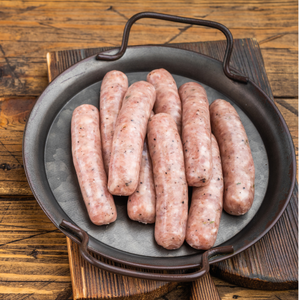

Original Breakfast Sausage Links - 9.3 oz
Beyond Meat
$8.99
Below are the available bulk discount rates for each individual item when you purchase a certain amount
- Buy 2 - 3 and get 2% off
- Buy 4 - 7 and get 4% off
- Buy 8 or above and get 8% off
(No reviews yet)

Write a Review

Beyond Meat
Original Breakfast Sausage Links - 9.3 oz
Traditional breakfast sausage links carry 440mg of sodium per serving. These plant-based links hold the same 8-link format at 240mg — a 45% reduction — while carrying both the American Heart Association's Heart-Check certification and recognition from the American Diabetes Association's Better Choices for Life program, two independent nutrition reviews most sausage never sees, plant-based or not.
- Skillet, griddle, or oven — links cook straight from frozen for weekday breakfasts, breakfast sandwiches, or alongside eggs and hash.
- Made with avocado oil in place of animal fat and built from a four-protein blend of pea, brown rice, red lentil, and faba bean — Non-GMO Project Verified.
- Vegan, kosher, and halal — a breakfast sausage format that fits plant-based, kosher, and halal tables without substitution.
Ethan Brown, founder of Beyond Meat, built the company on a simple bet: take the animal off the plate without asking anyone to give up the format they grew up eating. Original Breakfast Sausage Links, one of the category's most recognizable plant-based breakfast sausage links, is built to prove it — a griddle-ready link made from plants, still shaped, seasoned, and browned the way breakfast sausage always has been.
Each package holds about 8 links, formed from a protein blend of yellow pea, brown rice, red lentil, and faba bean protein, bound with avocado oil in place of pork fat, colored with a vegetable juice blend that includes beet, and shaped in a plant-based sodium alginate casing — no animal casing anywhere in the ingredient list.
Per serving, these links carry 5g of total fat and 9g of protein at 240mg of sodium — 45% less than a traditional breakfast sausage's 440mg. That reduction, paired with a saturated fat and cholesterol profile low enough to earn the American Heart Association's Heart-Check certification and recognition under the American Diabetes Association's Better Choices for Life program, puts this link in nutritional territory most breakfast sausage doesn't reach.
Cook links straight from frozen in a skillet over medium heat, turning until browned on all sides, or bake on a sheet pan according to package instructions for a hands-off breakfast platter. As a frozen vegan breakfast sausage, they hold up well in breakfast sandwiches, alongside pancakes, or crumbled into a breakfast burrito. Because the protein base leans on legumes and grains like pea, lentil, faba bean, and rice, these links are built for vegan, kosher, and halal eating rather than keto, paleo, or carnivore-style diets.
Suitable for vegan, kosher, and halal diets, and Non-GMO Project Verified. Keep frozen until ready to cook, storing in the freezer until you're ready to cook a batch.
Ingredients: Water, Yellow Pea Protein, Avocado Oil, Brown Rice Protein, Red Lentil Protein, Faba Bean Protein, 2% or Less of Natural Flavors, Inulin, Methylcellulose, Salt, Potassium Salt, Apple Extract, Spice, Psyllium Husk Fiber, Lemon Juice Concentrate, Vinegar, Pomegranate Concentrate, Pea Fiber, Calcium Chloride, Vegetable Juice Color (with Beet), Garlic Powder, Onion Powder, and Sodium Alginate Casing.
Common Questions
How does the nutrition profile compare to a traditional pork breakfast sausage link?
A typical pork breakfast sausage link runs about 170-200mg sodium per link and 8-9g of fat, with two links (a standard serving) landing near 440mg sodium and 17g fat. This product's equivalent serving carries 240mg sodium and 5g total fat, a 45% sodium reduction and roughly two-thirds less fat, while still delivering 9g of protein per serving versus the 5-6g typical of pork links of similar size. The calorie count also comes in lower since there's no rendered animal fat contributing to the total. The protein source is entirely plant-based (pea, rice, lentil, and faba bean), so the amino acid contribution comes from a blended profile rather than a single animal source.
How do four different plant proteins work together in one sausage?
Yellow pea, brown rice, red lentil, and faba bean proteins each have a different amino acid strengths and weaknesses — pea protein is high in lysine but lower in methionine, while rice protein supplies more methionine but less lysine, so combining them produces a more complete amino acid profile than any single plant source alone. Faba bean and red lentil proteins add additional branched-chain amino acids and help with the texture, giving the link a firmer bite that holds together during flipping and browning. Methylcellulose acts as a heat-activated binder, firming up as the link hits the hot skillet the way fat and collagen do in a meat sausage, then loosening slightly as it cools. Psyllium husk fiber and inulin add moisture retention and a small amount of soluble fiber, which isn't present at all in a conventional pork link.
Does this fit a keto, paleo, or carnivore eating plan?
It doesn't fit carnivore or paleo protocols, since both frameworks exclude legume-derived proteins and processed plant ingredients like methylcellulose and inulin — the entire product is built from pea, rice, lentil, and faba bean protein rather than animal meat. For keto, it's a marginal fit at best: at 5g fat and 9g protein per serving there's a higher protein-to-fat ratio than keto dieters typically target for satiety, and ingredients like inulin and pea fiber contribute a small amount of net carbs per link that a strict ketogenic macro count would need to track. If you're following keto loosely and prioritizing lower saturated fat over hitting an 70-80% fat macro ratio, it can work in moderation, but it's not built around fat-adaptation the way traditional sausage is.
What dishes work best with this sausage, and does the cooking method change?
It works in the same places a pork breakfast link would — biscuit sandwiches, alongside pancakes or waffles, crumbled into a breakfast burrito or hash, or wrapped in dough for a plant-based take on pigs in a blanket. Because there's no animal fat to render out, it cooks faster and doesn't need draining: straight from frozen in a skillet over medium heat, expect even browning in about 8-10 minutes with occasional turning, or 15-18 minutes baked at 400°F on a sheet pan with no oil needed. Avoid pressing down hard with a spatula while cooking, since without rendered fat providing internal moisture the link can dry out faster than pork if flattened or overcooked. It also crumbles well by hand once cooked, which makes it easy to break apart for a scramble or casserole.
What do the certifications on this product actually verify?
Non-GMO Project Verified means an independent third party tested the ingredients for genetically modified content and confirmed the product meets their traceability standard, which you can look up by product name in the Non-GMO Project's online verification database. The Heart-Check mark from the American Heart Association requires the product to meet specific limits on saturated fat, sodium, and cholesterol per serving, criteria this product meets at 240mg sodium and its plant-based fat profile with zero cholesterol. Kosher and halal certifications are granted by third-party certifying agencies that audit the ingredient sourcing and production line, which matters here since the sodium alginate casing and all protein sources are plant-derived with no animal-based inputs to raise a conflict. None of these are self-declared claims — each has a certifying body whose logo or certificate number can be checked independently.
What replaces animal casing and pork fat, and why does it matter?
The link is formed in a sodium alginate casing, a plant-derived polysaccharide extracted from brown seaweed rather than the collagen or animal intestine casing used on traditional sausage links. Avocado oil stands in for pork fat, providing the fat content needed for browning and mouthfeel while contributing monounsaturated fat instead of the saturated fat that dominates rendered pork fat. This combination is what allows the product to carry zero cholesterol and a different fat profile than conventional sausage while still browning and holding its shape on a skillet the same way a traditional link does. It also means there's no ambiguity about animal byproducts anywhere in the casing or binding system, which is relevant for anyone checking ingredient sourcing for religious dietary compliance.
Why is the sodium so much lower than typical sausage, and does it affect flavor?
Part of the reduction comes from replacing a portion of the salt with potassium salt (potassium chloride), which contributes a similar salty taste but doesn't add to sodium totals the way sodium chloride does. The rest comes from leaning on spice, garlic powder, onion powder, and natural flavors to build savory depth without relying on salt as the primary flavor carrier, along with apple extract and lemon juice concentrate for a subtle acidity that rounds out the seasoning. The tradeoff of potassium chloride is a slightly different aftertaste some people describe as faintly metallic or bitter at high concentrations, though at the levels used here it's blended in alongside the other seasonings rather than standing out on its own.
- __Storage_Location:
- Frozen
- __Volume:
- 675
- __Owner:
- TCFarm


