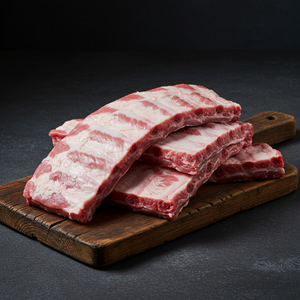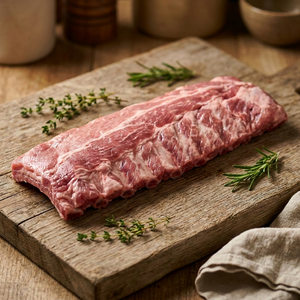

Loin Baby Back Ribs - 1.8 lb
TC Farm
$14.99
(No reviews yet)

Write a Review
TC Farm
Loin Baby Back Ribs - 1.8 lb
Baby back ribs are cut from the loin — the uppermost section of the rib cage, where the bones are shortest and the meat sits right against the spine, making them the most tender ribs on the animal. These racks come from one of two partner family farms — Farmer Keith's 550-acre operation raising about 250 hogs a year, or Farmer Kerry's farm in Montrose, Minnesota, where heritage forest hogs graze rotational pasture and wooded lots — both raised to the same TC Farm standard, without confinement barns, growth drugs, or soy.
- Year-round pasture and wooded-lot access on both farms — pigs root, range, and forage through every season, naturally.
- Fed transitional organic corn, barley, and alfalfa grown on-farm — soy-free, no fillers, no shortcuts, no outside feed sources.
- No growth drugs, no hormones — pigs grow 20% more slowly, building measurably higher Vitamin D and richer, more developed flavor throughout the muscle.
One full rack of loin baby back ribs — cut from the top of the rib cage where the bones curve shortest and the loin muscle runs right alongside them. Each rack averages about 1.8 lb (roughly 29 oz), frozen, and comes from one of two partner family farms: Farmer Keith's 550-acre operation or Farmer Kerry's farm in Montrose, Minnesota — both raised to the same exacting TC Farm standard.
Between these two farms, the herd stays small on purpose. Farmer Keith runs about 250 hogs a year across 550 acres — a ratio that would seem absurdly land-rich to any commodity operation. Farmer Kerry raises heritage forest hogs, a rare small lard heritage breed, on rotating green pastures and wooded lots, using a rotational grazing program he built around what he learned at culinary school in Sonoma County in the early 2000s. What both farms share: year-round outdoor access, no confinement barns, and pigs that behave the way pigs are actually built to behave — rooting, ranging, and moving through diverse forage.
The feed program is the other place these farms diverge from the industry. In U.S. commercial pork production, soybean meal is the default protein source in nearly every feed ration — it's cheap, dense, and ubiquitous. Both TC Farm partners leave it out entirely. Instead, the pigs eat transitional organic corn, barley, and alfalfa, all grown on-farm. Transitional organic means the feed crops are being raised under full USDA organic standards during the mandatory three-year window before a farm can receive final organic certification — same restrictions, same practices, just not yet carrying the final label. Dropping soy is uncommon enough that it costs more. For families managing soy allergies or anyone who simply wants a straight answer about what their pork ate, it matters.
Without growth drugs or added hormones, these hogs grow about 20% more slowly than conventionally raised pigs. That slower timeline isn't a side effect — it's the mechanism. More days on pasture means more time for intramuscular fat to develop and for the muscle to accumulate nutrients. Pasture-raised pork consistently shows higher Vitamin D levels than confinement-raised pork; sunlight exposure and outdoor forage are the direct reasons. Farmer Kerry's heritage forest hogs carry this further — he describes his animals' fat as tasting almost like butter, a result of heavier marbling than most heritage breeds combined with a diet built entirely around pasture and on-farm grain.
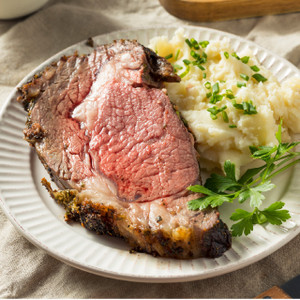
For cooking, baby back ribs reward patience. The most reliable method is low-and-slow smoke at 225°F for four to five hours, pulling when the meat has visibly drawn back from the bone ends and an instant-read thermometer reads at least 145°F internal — though most pitmasters take these to 190–200°F to fully render the connective tissue between the loin muscle and the bone. The 3-2-1 method works well: three hours unwrapped on the smoker, two hours wrapped tight in foil with a splash of apple cider or broth, then one hour back on unwrapped to set the bark. Oven braise at 300°F for three hours in a covered roasting pan is a strong alternative when a smoker isn't available. However you cook them, rest the rack loosely tented for at least ten minutes before cutting between the bones.
Ingredients: Pork.
Common Questions
Where exactly on the pig do baby back ribs come from, and what makes them different from spare ribs?
Baby back ribs are cut from the loin primal — the upper section of the rib cage, where the rib bones connect closest to the spine. The bones here are shorter (typically 3 to 6 inches) than spare rib bones, and the meat that runs along them is part of the loin muscle, which does less work than the belly muscles further down the animal. Spare ribs come from the lower rib cage and include more cartilage, connective tissue, and belly fat — they're larger, heavier, and take longer to cook. Baby backs are leaner per bone, more uniform in shape, and generally considered the more tender of the two cuts, though spare ribs carry more total fat and suit longer braises well.
How rare is soy-free pork in the United States, and why does it matter?
Soybean meal is the primary protein source in the vast majority of commercial U.S. hog feed rations — it's inexpensive, high in protein, and built into nearly every commodity feed formula at scale. Raising pigs on a soy-free diet requires replacing that protein with alternatives like barley, alfalfa, and field peas, which cost more and are harder to source consistently. Both TC Farm partner farms — Farmer Keith's and Farmer Kerry's — grow their own soy-free feed on-farm, which is how they control it. For families managing soy allergies or soy sensitivities, this distinction is meaningful: while the soy protein itself is largely degraded through digestion, many allergy-sensitive households prefer to avoid it entirely at the feed level, and clear documentation of soy-free raising is genuinely uncommon in retail pork.
What does 'transitional organic' mean, and why doesn't TC Farm's pork carry the USDA Organic label?
USDA Organic certification for feed crops requires a mandatory three-year transition period during which the land must be farmed under full organic standards — no synthetic pesticides, no synthetic fertilizers, no GMO seed — before the crops can carry the certified organic label. Feed grown during that window meets the same standards as certified organic feed, but legally cannot be called organic until the three years are complete. Both TC Farm partner farms grow their own feed under these practices and are in that transitional period, which is why TC Farm uses the term 'transitional organic' rather than claiming USDA Organic outright. Claiming certified organic before the window closes would be inaccurate; TC Farm names it plainly instead.
Does 'pasture-raised' on a pork label have a legal definition in the United States?
No. Unlike USDA Organic, there is no federal regulatory standard that defines 'pasture-raised' for pork — any producer can use the phrase on a label without meeting a defined acreage, access, or time-outdoors requirement. What TC Farm's partner farms actually provide is documented and specific: Farmer Keith's 550-acre farm runs approximately 250 hogs per year across pasture and wooded lots with year-round outdoor access and no confinement barns. Farmer Kerry's farm in Montrose, Minnesota uses a rotational grazing system across green pastures and wooded lots, cycling fields to allow recovery time between groups. Year-round outdoor access with rotational management is meaningfully different from the minimum outdoor-access standards that some 'pasture-raised' labels imply — but buyers are right to ask, because the label itself doesn't guarantee it.
Does the way these pigs are raised actually affect the nutrition or flavor of the pork?
Yes, and both effects are measurable. Pigs with consistent outdoor access and sunlight exposure produce pork with higher Vitamin D levels than confinement-raised pork — this is documented in livestock nutrition research and follows the same mechanism as Vitamin D production in humans. Slower growth — these hogs grow roughly 20% more slowly than conventionally raised pigs without growth drugs — means more time for intramuscular fat to deposit and for the muscle fiber itself to develop complexity. Farmer Kerry's heritage forest hogs carry this further: the breed is a small lard-type heritage variety that marbles more heavily than most heritage breeds, and Kerry attributes the character of the fat directly to the combination of breed genetics, pasture diet, and on-farm grain. These aren't marketing claims layered onto a commodity product — they follow directly from documented differences in raising practices.
What is the best way to cook baby back ribs, and what internal temperature should I target?
USDA recommends a minimum internal temperature of 145°F for whole cuts of pork, but baby back ribs cooked only to 145°F will be technically safe and still tough — the collagen between the loin meat and the bone hasn't had time to render. Most experienced rib cooks pull them between 190°F and 203°F, which is the range where collagen converts to gelatin and the meat begins to pull cleanly from the bone. The most consistent method is low-and-slow smoke at 225°F for four to five hours. The 3-2-1 method — three hours unwrapped on the smoker, two hours wrapped in foil with a small amount of liquid, one hour back on unwrapped — works well for a rack this size and produces a tender interior with a set bark. Oven braise at 300°F in a covered pan for about three hours is a reliable indoor alternative. Rest the rack at least ten minutes before slicing between bones.
How should I store and thaw these ribs?
Keep the rack frozen until the day before you plan to cook it. The safest and most effective thaw method is transferring the sealed package to the refrigerator 24 hours before cooking — a rack this size (approximately 1.8 lb) will be fully thawed within that window at standard refrigerator temperatures of 35–40°F. If you need to thaw faster, submerge the sealed package in cold water, changing the water every 30 minutes; a rack this size typically thaws in two to three hours using this method. Do not thaw at room temperature — the outer surface of the meat will reach the bacterial growth range (above 40°F) well before the center thaws. Kept continuously frozen, the rack will hold quality for up to twelve months.
Between these two farms, the herd stays small on purpose. Farmer Keith runs about 250 hogs a year across 550 acres — a ratio that would seem absurdly land-rich to any commodity operation. Farmer Kerry raises heritage forest hogs, a rare small lard heritage breed, on rotating green pastures and wooded lots, using a rotational grazing program he built around what he learned at culinary school in Sonoma County in the early 2000s. What both farms share: year-round outdoor access, no confinement barns, and pigs that behave the way pigs are actually built to behave — rooting, ranging, and moving through diverse forage.
The feed program is the other place these farms diverge from the industry. In U.S. commercial pork production, soybean meal is the default protein source in nearly every feed ration — it's cheap, dense, and ubiquitous. Both TC Farm partners leave it out entirely. Instead, the pigs eat transitional organic corn, barley, and alfalfa, all grown on-farm. Transitional organic means the feed crops are being raised under full USDA organic standards during the mandatory three-year window before a farm can receive final organic certification — same restrictions, same practices, just not yet carrying the final label. Dropping soy is uncommon enough that it costs more. For families managing soy allergies or anyone who simply wants a straight answer about what their pork ate, it matters.
Without growth drugs or added hormones, these hogs grow about 20% more slowly than conventionally raised pigs. That slower timeline isn't a side effect — it's the mechanism. More days on pasture means more time for intramuscular fat to develop and for the muscle to accumulate nutrients. Pasture-raised pork consistently shows higher Vitamin D levels than confinement-raised pork; sunlight exposure and outdoor forage are the direct reasons. Farmer Kerry's heritage forest hogs carry this further — he describes his animals' fat as tasting almost like butter, a result of heavier marbling than most heritage breeds combined with a diet built entirely around pasture and on-farm grain.
For cooking, baby back ribs reward patience. The most reliable method is low-and-slow smoke at 225°F for four to five hours, pulling when the meat has visibly drawn back from the bone ends and an instant-read thermometer reads at least 145°F internal — though most pitmasters take these to 190–200°F to fully render the connective tissue between the loin muscle and the bone. The 3-2-1 method works well: three hours unwrapped on the smoker, two hours wrapped tight in foil with a splash of apple cider or broth, then one hour back on unwrapped to set the bark. Oven braise at 300°F for three hours in a covered roasting pan is a strong alternative when a smoker isn't available. However you cook them, rest the rack loosely tented for at least ten minutes before cutting between the bones.
Ingredients: Pork.
Common Questions
Where exactly on the pig do baby back ribs come from, and what makes them different from spare ribs?
Baby back ribs are cut from the loin primal — the upper section of the rib cage, where the rib bones connect closest to the spine. The bones here are shorter (typically 3 to 6 inches) than spare rib bones, and the meat that runs along them is part of the loin muscle, which does less work than the belly muscles further down the animal. Spare ribs come from the lower rib cage and include more cartilage, connective tissue, and belly fat — they're larger, heavier, and take longer to cook. Baby backs are leaner per bone, more uniform in shape, and generally considered the more tender of the two cuts, though spare ribs carry more total fat and suit longer braises well.
How rare is soy-free pork in the United States, and why does it matter?
Soybean meal is the primary protein source in the vast majority of commercial U.S. hog feed rations — it's inexpensive, high in protein, and built into nearly every commodity feed formula at scale. Raising pigs on a soy-free diet requires replacing that protein with alternatives like barley, alfalfa, and field peas, which cost more and are harder to source consistently. Both TC Farm partner farms — Farmer Keith's and Farmer Kerry's — grow their own soy-free feed on-farm, which is how they control it. For families managing soy allergies or soy sensitivities, this distinction is meaningful: while the soy protein itself is largely degraded through digestion, many allergy-sensitive households prefer to avoid it entirely at the feed level, and clear documentation of soy-free raising is genuinely uncommon in retail pork.
What does 'transitional organic' mean, and why doesn't TC Farm's pork carry the USDA Organic label?
USDA Organic certification for feed crops requires a mandatory three-year transition period during which the land must be farmed under full organic standards — no synthetic pesticides, no synthetic fertilizers, no GMO seed — before the crops can carry the certified organic label. Feed grown during that window meets the same standards as certified organic feed, but legally cannot be called organic until the three years are complete. Both TC Farm partner farms grow their own feed under these practices and are in that transitional period, which is why TC Farm uses the term 'transitional organic' rather than claiming USDA Organic outright. Claiming certified organic before the window closes would be inaccurate; TC Farm names it plainly instead.
Does 'pasture-raised' on a pork label have a legal definition in the United States?
No. Unlike USDA Organic, there is no federal regulatory standard that defines 'pasture-raised' for pork — any producer can use the phrase on a label without meeting a defined acreage, access, or time-outdoors requirement. What TC Farm's partner farms actually provide is documented and specific: Farmer Keith's 550-acre farm runs approximately 250 hogs per year across pasture and wooded lots with year-round outdoor access and no confinement barns. Farmer Kerry's farm in Montrose, Minnesota uses a rotational grazing system across green pastures and wooded lots, cycling fields to allow recovery time between groups. Year-round outdoor access with rotational management is meaningfully different from the minimum outdoor-access standards that some 'pasture-raised' labels imply — but buyers are right to ask, because the label itself doesn't guarantee it.
Does the way these pigs are raised actually affect the nutrition or flavor of the pork?
Yes, and both effects are measurable. Pigs with consistent outdoor access and sunlight exposure produce pork with higher Vitamin D levels than confinement-raised pork — this is documented in livestock nutrition research and follows the same mechanism as Vitamin D production in humans. Slower growth — these hogs grow roughly 20% more slowly than conventionally raised pigs without growth drugs — means more time for intramuscular fat to deposit and for the muscle fiber itself to develop complexity. Farmer Kerry's heritage forest hogs carry this further: the breed is a small lard-type heritage variety that marbles more heavily than most heritage breeds, and Kerry attributes the character of the fat directly to the combination of breed genetics, pasture diet, and on-farm grain. These aren't marketing claims layered onto a commodity product — they follow directly from documented differences in raising practices.
What is the best way to cook baby back ribs, and what internal temperature should I target?
USDA recommends a minimum internal temperature of 145°F for whole cuts of pork, but baby back ribs cooked only to 145°F will be technically safe and still tough — the collagen between the loin meat and the bone hasn't had time to render. Most experienced rib cooks pull them between 190°F and 203°F, which is the range where collagen converts to gelatin and the meat begins to pull cleanly from the bone. The most consistent method is low-and-slow smoke at 225°F for four to five hours. The 3-2-1 method — three hours unwrapped on the smoker, two hours wrapped in foil with a small amount of liquid, one hour back on unwrapped — works well for a rack this size and produces a tender interior with a set bark. Oven braise at 300°F in a covered pan for about three hours is a reliable indoor alternative. Rest the rack at least ten minutes before slicing between bones.
How should I store and thaw these ribs?
Keep the rack frozen until the day before you plan to cook it. The safest and most effective thaw method is transferring the sealed package to the refrigerator 24 hours before cooking — a rack this size (approximately 1.8 lb) will be fully thawed within that window at standard refrigerator temperatures of 35–40°F. If you need to thaw faster, submerge the sealed package in cold water, changing the water every 30 minutes; a rack this size typically thaws in two to three hours using this method. Do not thaw at room temperature — the outer surface of the meat will reach the bacterial growth range (above 40°F) well before the center thaws. Kept continuously frozen, the rack will hold quality for up to twelve months.
- __Storage_Location:
- Frozen
- __Volume:
- 1500
- __badge:
- Pasture-Raised
- __Owner:
- TCFarm