



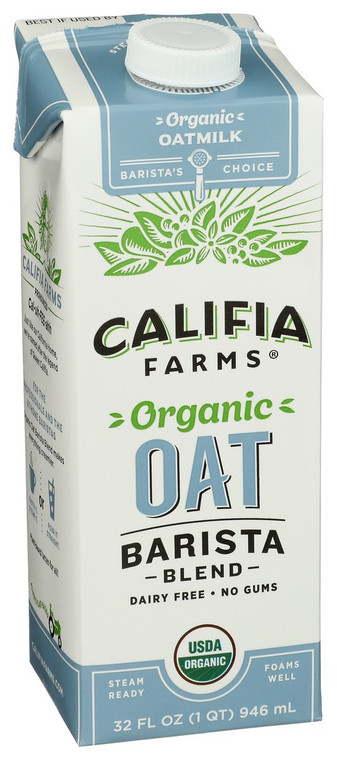
Barista Blend Oat Milk - 32 fl oz
Califia
$5.49
Below are the available bulk discount rates for each individual item when you purchase a certain amount
- Buy 2 - 2 and get 2% off
- Buy 3 - 5 and get 4% off
- Buy 6 or above and get 8% off
(No reviews yet)

Write a Review
Califia
Barista Blend Oat Milk - 32 fl oz
Steam it, froth it, or pour it straight into a cold brew — this Organic Oat Barista Blend is formulated specifically to behave like dairy under heat and pressure, building the same microfoam a milk steamer pulls from whole milk, without the stabilizing gums many oat-based barista blends lean on to fake that texture.
- Built for espresso: steams into stable microfoam for lattes and cappuccinos, or stirs straight into brewed coffee for a lightened, creamy cup
- Three ingredients total — organic oats, organic sunflower oil, and sea salt — with no added gums, stabilizers, or emulsifying phosphates to force the froth
- Certified organic, Non-GMO Project Verified, and suitable for vegan, dairy-free, and gluten-free diets
Cafe-quality foam starts with fat and protein ratios most non-dairy oat milks don't bother getting right. This Organic Oat Barista Blend is built around organic oats and organic sunflower oil in a ratio engineered to hold air the way dairy milk does — so it steams, froths, and pours with real body instead of collapsing into a thin, watery layer on top of your espresso.
The ingredient list is short on purpose: organic oatmilk (water, organic oats), organic sunflower oil, and sea salt. Nothing else. No gums, no added sugars, no emulsifying phosphates standing in for real fat content. Each 8 fl oz serving carries 130 calories, 3g of naturally-occurring sugar, and 1g of protein — a lighter profile than whole dairy milk while still delivering enough fat to foam properly. Because oats are naturally carb-forward, this blend isn't a fit for strict keto, paleo, or carnivore diets, though it remains a solid dairy-free option for everyone else.
Use it exactly like you'd use steamed milk: pull a shot, steam a pitcher of this blend to 150-160F, and pour for a latte or cappuccino with real latte art potential. For iced drinks, shake or blend it cold straight into cold brew, or use it as the base for an oat milk matcha or chai. It also works stirred straight into a mug of drip coffee for a creamier, dairy-free cup without a coffee shop trip.
Certified organic and Non-GMO Project Verified, this plant-based, non-dairy oat milk is vegan and gluten-free by formulation. Keep refrigerated at all times and shake well before each use to maintain its steaming and frothing performance.
Ingredients: Organic Oatmilk (Water, Organic Oats), Organic Sunflower Oil, and Sea Salt.
Common Questions
How does this oat milk compare nutritionally to dairy milk and to standard oat milk?
One 8 fl oz serving of this Barista Blend has 130 calories, about 4.5g of fat, 1g of protein, and 3g of naturally-occurring sugar, with zero added sugar. Whole dairy milk runs closer to 150 calories, 8g fat, 8g protein, and 12g of lactose-derived sugar in the same serving size. Standard (non-barista) oat milks typically carry only 2-2.5g of fat per serving, which is why they froth thin and separate in espresso — this blend deliberately raises the fat content using sunflower oil to close that gap with dairy's foaming behavior. Protein stays low at 1g regardless, since oats simply don't contribute much protein compared to dairy or soy bases.
What actually makes this oat milk foam like steamed dairy milk?
Foam stability comes down to fat and protein working together to trap air bubbles and keep them from collapsing. In dairy milk, casein proteins form a flexible film around air bubbles while milkfat reinforces that film's structure. This blend can't rely on casein, so it compensates by raising the fat ratio through organic sunflower oil, which coats and stabilizes the air bubbles mechanically even with only 1g of protein present. That's why it holds a steamed microfoam texture and supports latte art, while a lower-fat oat milk collapses into a flat, watery layer within seconds of pouring.
Does this fit keto, paleo, or carnivore diets?
For keto, the numbers work in moderation: 3g of total sugar per serving with no added sugars keeps net carbs low enough that most keto trackers can fit a splash in coffee, though it's not zero-carb the way heavy cream is. It does not fit paleo or carnivore protocols, since both exclude oats and other grains entirely regardless of processing method — the oat base itself is the disqualifier, not any additive. If you're strict paleo or carnivore, this isn't a substitute; it's built for people avoiding dairy or animal products, not people avoiding grains.
What can I make with this besides coffee drinks?
Because the fat content is closer to dairy than most plant milks, it holds up in recipes that would normally break with thin oat milk: creamy soups, béchamel-style sauces, oat milk mac and cheese, mashed potatoes, and pancake or waffle batter all work as 1:1 dairy substitutes. For hot applications like sauces or soups, keep heat moderate and stir rather than hard-boil, since the sunflower oil can separate slightly under prolonged high heat the way any plant-based fat can. It also works cold in overnight oats, smoothies, or as a base for homemade oat milk chai concentrate.
What do the organic and Non-GMO Project Verified labels actually confirm here?
USDA Organic certification means the oats were grown without synthetic pesticides, herbicides, or fertilizers, and the product was processed under a certified organic supply chain with third-party annual inspection. Non-GMO Project Verified goes further than organic alone by requiring ongoing testing of at-risk ingredients against a specific action threshold, verified by an accredited third-party auditor rather than the manufacturer. The Kosher certification confirms the product and its production line were reviewed by a certifying rabbinical agency for compliance with kosher food preparation standards. All three are checkable — the certifying body's name and logo appear directly on the label, and each maintains a public database where you can verify the specific certificate.
Why is the ingredient list so short compared to other oat milk brands?
Most oat milks add gums like gellan or xanthan, plus emulsifying phosphates, to fake body and prevent separation when protein and fat content run low. This blend instead uses a higher ratio of organic sunflower oil to organic oatmilk, so the fat itself does the work that stabilizers usually do — holding texture, preventing wateriness, and supporting foam. The tradeoff is that shaking before use matters more here, since there's no gum suspending the oil; without added stabilizers, natural separation is expected and reversible with a shake, not a sign of spoilage.
The ingredient list is short on purpose: organic oatmilk (water, organic oats), organic sunflower oil, and sea salt. Nothing else. No gums, no added sugars, no emulsifying phosphates standing in for real fat content. Each 8 fl oz serving carries 130 calories, 3g of naturally-occurring sugar, and 1g of protein — a lighter profile than whole dairy milk while still delivering enough fat to foam properly. Because oats are naturally carb-forward, this blend isn't a fit for strict keto, paleo, or carnivore diets, though it remains a solid dairy-free option for everyone else.
Use it exactly like you'd use steamed milk: pull a shot, steam a pitcher of this blend to 150-160F, and pour for a latte or cappuccino with real latte art potential. For iced drinks, shake or blend it cold straight into cold brew, or use it as the base for an oat milk matcha or chai. It also works stirred straight into a mug of drip coffee for a creamier, dairy-free cup without a coffee shop trip.
Certified organic and Non-GMO Project Verified, this plant-based, non-dairy oat milk is vegan and gluten-free by formulation. Keep refrigerated at all times and shake well before each use to maintain its steaming and frothing performance.
Ingredients: Organic Oatmilk (Water, Organic Oats), Organic Sunflower Oil, and Sea Salt.
Common Questions
How does this oat milk compare nutritionally to dairy milk and to standard oat milk?
One 8 fl oz serving of this Barista Blend has 130 calories, about 4.5g of fat, 1g of protein, and 3g of naturally-occurring sugar, with zero added sugar. Whole dairy milk runs closer to 150 calories, 8g fat, 8g protein, and 12g of lactose-derived sugar in the same serving size. Standard (non-barista) oat milks typically carry only 2-2.5g of fat per serving, which is why they froth thin and separate in espresso — this blend deliberately raises the fat content using sunflower oil to close that gap with dairy's foaming behavior. Protein stays low at 1g regardless, since oats simply don't contribute much protein compared to dairy or soy bases.
What actually makes this oat milk foam like steamed dairy milk?
Foam stability comes down to fat and protein working together to trap air bubbles and keep them from collapsing. In dairy milk, casein proteins form a flexible film around air bubbles while milkfat reinforces that film's structure. This blend can't rely on casein, so it compensates by raising the fat ratio through organic sunflower oil, which coats and stabilizes the air bubbles mechanically even with only 1g of protein present. That's why it holds a steamed microfoam texture and supports latte art, while a lower-fat oat milk collapses into a flat, watery layer within seconds of pouring.
Does this fit keto, paleo, or carnivore diets?
For keto, the numbers work in moderation: 3g of total sugar per serving with no added sugars keeps net carbs low enough that most keto trackers can fit a splash in coffee, though it's not zero-carb the way heavy cream is. It does not fit paleo or carnivore protocols, since both exclude oats and other grains entirely regardless of processing method — the oat base itself is the disqualifier, not any additive. If you're strict paleo or carnivore, this isn't a substitute; it's built for people avoiding dairy or animal products, not people avoiding grains.
What can I make with this besides coffee drinks?
Because the fat content is closer to dairy than most plant milks, it holds up in recipes that would normally break with thin oat milk: creamy soups, béchamel-style sauces, oat milk mac and cheese, mashed potatoes, and pancake or waffle batter all work as 1:1 dairy substitutes. For hot applications like sauces or soups, keep heat moderate and stir rather than hard-boil, since the sunflower oil can separate slightly under prolonged high heat the way any plant-based fat can. It also works cold in overnight oats, smoothies, or as a base for homemade oat milk chai concentrate.
What do the organic and Non-GMO Project Verified labels actually confirm here?
USDA Organic certification means the oats were grown without synthetic pesticides, herbicides, or fertilizers, and the product was processed under a certified organic supply chain with third-party annual inspection. Non-GMO Project Verified goes further than organic alone by requiring ongoing testing of at-risk ingredients against a specific action threshold, verified by an accredited third-party auditor rather than the manufacturer. The Kosher certification confirms the product and its production line were reviewed by a certifying rabbinical agency for compliance with kosher food preparation standards. All three are checkable — the certifying body's name and logo appear directly on the label, and each maintains a public database where you can verify the specific certificate.
Why is the ingredient list so short compared to other oat milk brands?
Most oat milks add gums like gellan or xanthan, plus emulsifying phosphates, to fake body and prevent separation when protein and fat content run low. This blend instead uses a higher ratio of organic sunflower oil to organic oatmilk, so the fat itself does the work that stabilizers usually do — holding texture, preventing wateriness, and supporting foam. The tradeoff is that shaking before use matters more here, since there's no gum suspending the oil; without added stabilizers, natural separation is expected and reversible with a shake, not a sign of spoilage.
- __Storage_Location:
- Dry
- __Volume:
- 350
- __Owner:
- TCFarm
- __badge:
- Organic
Related Products
-
-
-
-
Sale


