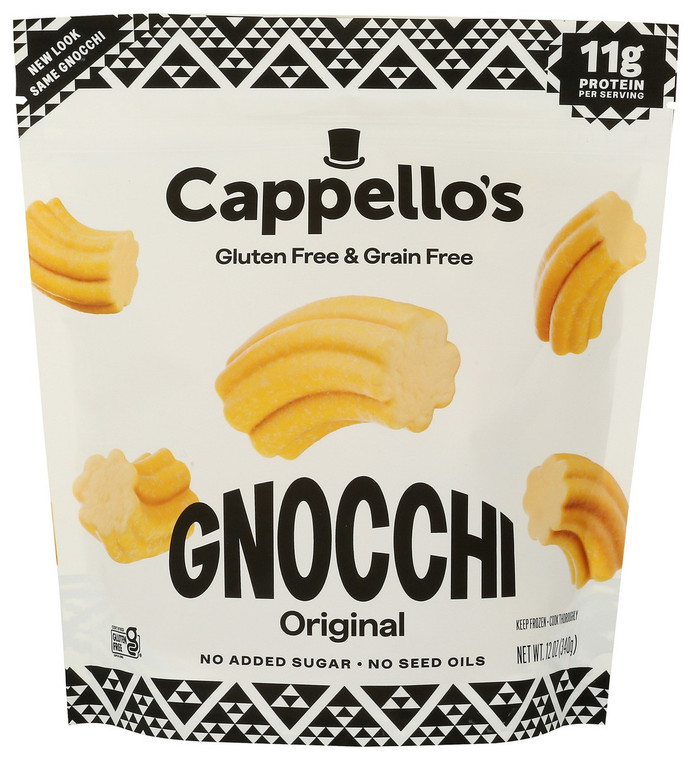
Cappello's set out to reinvent pasta without leaning on wheat, corn, rice, legumes, or soy — and gnocchi was the hardest dumpling to crack. The result is a grain-free, gluten-free gnocchi built from almond flour, cage-free eggs, organic potatoes, and tapioca starch, delivering 11 grams of protein per serving in a dumpling still pillowy enough to hold sauce.
Each 12 oz bag is frozen fresh to lock in the texture of the almond-flour dough before it hits your pot, and it should stay in the freezer until you're ready to boil it straight from frozen. The cage-free eggs come from hens raised uncaged and free to roam in open buildings, and the almond flour itself contributes protein, fiber, and healthy fats that a standard wheat-and-potato gnocchi doesn't carry.
Boil the gnocchi straight from frozen for a few minutes until they float, then finish in a hot pan with butter, olive oil, or your sauce of choice — the quick sear crisps the outside while keeping the inside tender. They hold up well under mushroom cream sauces, brown butter and sage, pesto, or a simple red sauce.
Home cooks who've switched over from wheat-based gnocchi describe a texture close to a from-scratch batch, with the note that the almond-flour dough needs closer attention at the boil than conventional gnocchi.
- "This was so good! My husband used it in a soup recipe with crushed tomatoes and coconut milk and it was delicious! I actually love this more than other brands of Gnocchi!" — Verified Buyer
- "We tried and my husband and I loved this product. We fried in a bit of butter salt and pepper. Or you could use as a main dish with sautéed vegetables. Plus gluten free" — Verified Buyer
- "Best Gluten Free gnocchi out there! Taste like Nona's!" — Verified Buyer
Grain-free, gluten-free, kosher, and Paleo-friendly, Cappello's Almond Flour Gnocchi keeps to a short, recognizable ingredient list with no gums, modified starches, or fillers. Keep frozen until ready to boil.
Ingredients: Potatoes, Water, Almond Flour, Eggs, Tapioca Starch, Sea Salt, and 2% or Less of Mono- and Diglycerides.
Common QuestionsHow does Cappello's gnocchi compare nutritionally to a conventional potato-and-wheat gnocchi?A typical wheat-flour gnocchi runs about 3-4 grams of protein per 100 grams, with almost all of its calories coming from refined wheat starch and potato starch and essentially no fiber. Cappello's swaps a portion of that starch base for almond flour, which pushes protein to 11 grams per serving along with fiber and unsaturated fat that a wheat version doesn't contribute. The tradeoff is texture: almond flour dough is more delicate at the boil, so it needs a shorter cook time and gentler handling than a wheat-based gnocchi. Both versions still lean on potato as the primary structural starch, so total carbohydrate counts land in a similar range.
What does almond flour actually add beyond being a gluten substitute?Almond flour is roughly 21 grams of protein and 50 grams of fat per 100 grams, with that fat skewing heavily toward monounsaturated fat similar to olive oil, plus around 10 grams of fiber. In this gnocchi, that composition is what pushes protein to 11 grams per serving, a number a standard wheat-flour dumpling can't reach because wheat gluten proteins are a fraction of that density. The fiber and fat also slow digestion of the starch component, which is part of why the dough behaves differently in the pot than a pure-starch dumpling. It's a functional ingredient here, not just a flour substitute for texture.
Does this gnocchi fit a keto, paleo, or carnivore diet?It fits paleo cleanly since it's grain-free, legume-free, soy-free, and built from almond flour, eggs, and potatoes rather than wheat. It does not fit carnivore, since the base ingredients are plant-derived starches and nut flour rather than animal products. For strict keto it's a harder fit: potatoes and tapioca starch are still significant carbohydrate sources, so total carbs per serving land well above what a 20-50 gram daily net-carb keto target usually allows for a single side dish. If you're keto, treat this as an occasional grain-free indulgence rather than a everyday staple.
What dishes work best with this gnocchi, and does the recipe need adjusting?It holds up well in brown butter and sage, mushroom cream sauce, pesto, simple red sauce, and even dropped into soups like tomato-coconut broth, based on how buyers have actually used it. Because the dough is almond-flour based rather than pure wheat starch, it cooks faster and can go soft if boiled too long, so pull the pieces the moment they float rather than giving them the extra minute you might use for a store-bought wheat gnocchi. A quick pan-sear in butter or olive oil after boiling firms the exterior back up and is the step most reviewers say makes the difference. It is not a direct swap into recipes calling for baked or fried gnocchi without that initial boil, since raw almond-flour dough won't hold together the same way wheat dough does.
What do the cage-free and kosher certifications on this product actually guarantee?Cage-free means the hens supplying the eggs are raised uncaged in open indoor barns with room to move, rather than in battery cages, though it doesn't specify outdoor access the way pasture-raised claims do. The kosher certification means the product and its production process were reviewed by a certifying body to confirm compliance with kosher dietary law, which you can typically verify by looking up the certifying symbol printed on the package against that agency's public registry. The glyphosate residue free claim indicates the product was tested and came back below detectable glyphosate levels, a pesticide residue check that isn't required for standard gluten-free labeling. None of these claims are self-declared marketing terms; each corresponds to a specific third-party check.
Why is potato listed as the first ingredient in a product marketed around almond flour?Potato and water together form the base and moisture content of the dough, while almond flour, eggs, and tapioca starch build the protein and structure around it, which is standard for gnocchi since potato starch is what gives the dumpling its classic soft, pillowy bite. Ingredient lists are ordered by weight, so potato leading the list reflects that it's the largest component by mass, not that almond flour is a minor additive. The almond flour's role is nutritional and textural rather than volumetric: it's what raises protein to 11 grams per serving and replaces the wheat flour a conventional recipe would otherwise use for binding. The short ingredient list, with no gums or modified starches, is a direct result of using potato's natural starch to do the binding job instead of synthetic stabilizers.