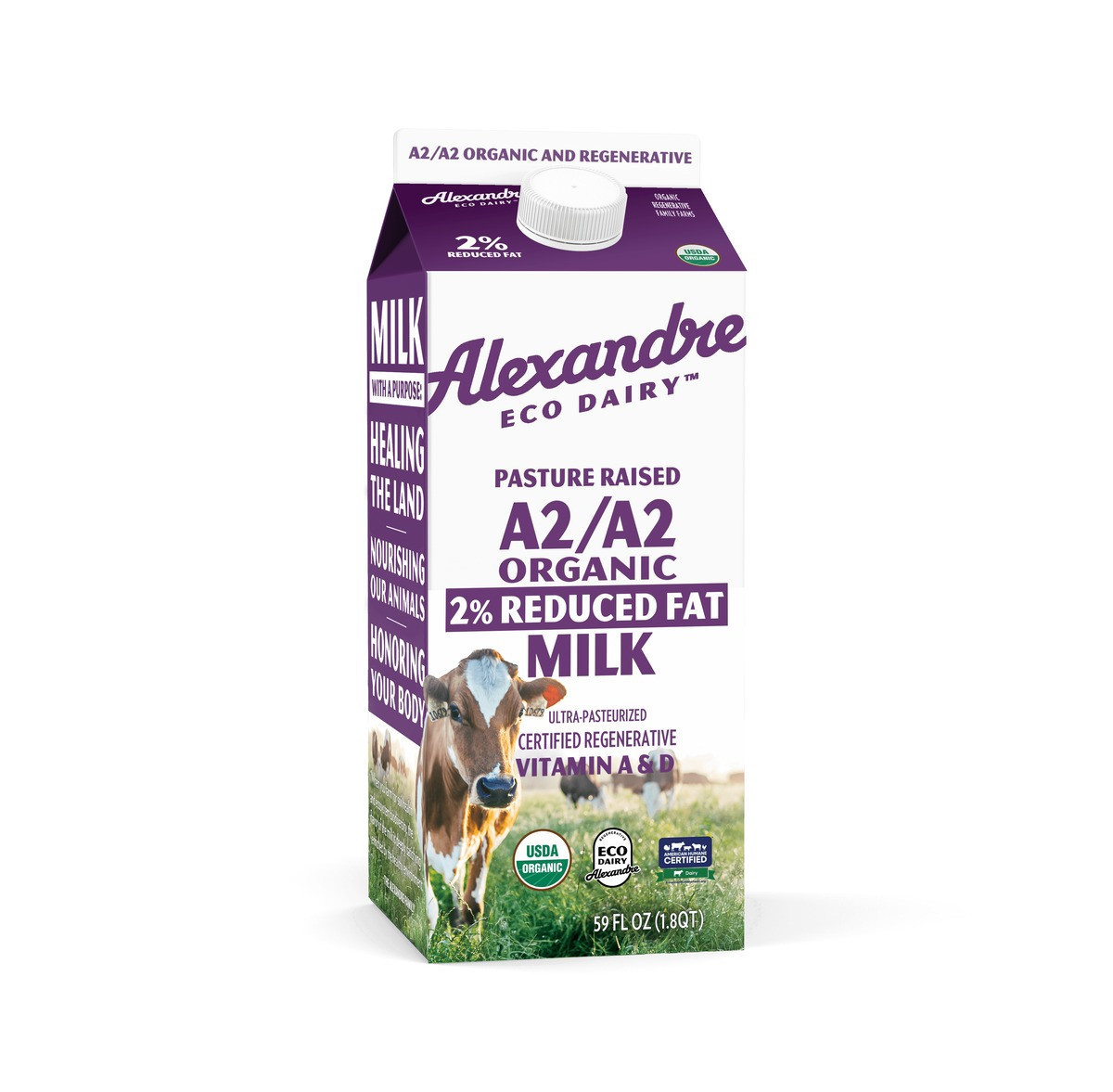
A2 Grass-Fed 2% Milk - 59 fl oz
Alexandre Family Farm
$7.49
Below are the available bulk discount rates for each individual item when you purchase a certain amount
- Buy 6 or above and get 5% off
(No reviews yet)

Write a Review

Alexandre Family Farm
A2 Grass-Fed 2% Milk - 59 fl oz
Alexandre Family Farm cows produce only A2/A2 beta-casein — the protein structure closer to what's found in mother's milk, without the A1 protein many people find harder on digestion. This isn't a marketing claim you can verify by squinting at a typical milk carton; every animal in the herd has been genetically confirmed A2/A2, generation after generation, on the same Northern California coastal pasture the family has grazed for five generations.
- Pour it over cereal, froth it for coffee, or drink it straight — a starting point for shoppers who've stepped away from milk over A1-related digestive discomfort and want to try again.
- Raised on a single Northern California coastal dairy where green pasture grows 365 days a year; the herd is Regenerative Organic and verified by the Savory Institute's Land to Market program for measurable soil health and biodiversity outcomes.
- Certified Organic, Kosher, and A2/A2 — no A1 beta-casein, no synthetic hormones, no antibiotics, from a 5th-generation family farm.
Alexandre Family Farm sits on the Northern California coast, where fog off the Pacific keeps pasture green every month of the year — a constant food source for a herd of crossbreed cows selected specifically for A2/A2 beta-casein. Blake and Stephanie Alexandre, the fifth generation to farm this land, run the operation with their five children and their spouses.
This is the 2% reduced-fat version of their organic A2/A2 milk — 50% less milkfat than their whole milk, dropping from 10 grams to 5 grams of fat per serving, while keeping the same A2/A2 protein and grass-fed nutrition profile. Each bottle holds 48 oz. The milk is ultra-pasteurized, which extends its fridge life without changing what's in the bottle.
Because the herd grazes on nutrient-dense pasture year-round rather than a seasonal or grain-heavy diet, the milk tests higher in Omega-3 fatty acids and CLAs (conjugated linoleic acids) than milk from grain-finished herds — nutrients tied to the cows' pasture-based diet, not something added at the processing stage.
Use it anywhere you'd use standard 2% milk — over cereal, in a latte, folded into a bechamel — the reduced fat content steams and froths similarly to store-bought 2%, just from a different starting herd.
Certified Organic and Kosher, suitable for vegetarian diets, and free of A1 beta-casein for those managing sensitivity to it. Note that as a dairy product, this milk isn't compatible with strict paleo or carnivore eating patterns, though its natural lactose content (about 12g of carbs per cup) means it can fit into a moderate keto approach in small amounts. Keep refrigerated and consume by the date on the cap.
Ingredients: Organic Milk, Organic Nonfat Milk, Vitamin D3, and Vitamin A Palmitate.
Common Questions
How does this milk compare nutritionally to a standard carton of 2% milk from the grocery store?
Both are 2% reduced-fat milk with similar core macros — about 120 calories, 5 grams of fat, and 8 grams of protein per 8-ounce serving. The difference shows up in the fat quality and micronutrient profile rather than the label panel. Because the Alexandre Family Farm herd grazes on pasture year-round instead of eating a grain-heavy feedlot ration for part of the year, independent testing on grass-fed dairy consistently shows higher levels of Omega-3 fatty acids and conjugated linoleic acid (CLA) compared to milk from grain-finished herds. The protein source is also different: this milk comes only from cows selected for the A2/A2 beta-casein gene, while conventional milk is a mix of A1 and A2 beta-casein unless specifically labeled otherwise.
What is CLA and why does it matter that this milk has more of it?
CLA stands for conjugated linoleic acid, a naturally occurring fatty acid produced in a cow's gut when it digests fresh green grass rather than grain or stored silage. Research on dairy fat composition has found that milk from cows on a full grass diet can contain two to five times more CLA than milk from grain-fed herds, since the rumen bacteria that generate CLA are more active when digesting high-fiber pasture. CLA has been studied for its potential role in supporting lean body mass and moderating inflammation, though most of that research is still in early stages. In this milk, the CLA and Omega-3 content come directly from the cows' year-round coastal pasture diet, not from any additive or processing step.
Does this milk fit a keto, paleo, or carnivore diet?
At 5 grams of fat and roughly 5-6 grams of carbohydrate (from lactose) per 8-ounce serving, this milk sits in a middle zone that works for paleo and many whole-foods-based diets but requires some math on strict keto or carnivore protocols. A single serving takes up a meaningful share of a 20-25 gram daily carb allowance on keto, so it's typically used in smaller amounts — a splash in coffee rather than a full glass. Carnivore purists who exclude all plant-derived sugars will still count the lactose here as a carbohydrate, even though the protein and fat come entirely from an animal source. For paleo followers focused on avoiding grain-fed dairy and A1 beta-casein, this milk's A2/A2 profile and pasture-based sourcing generally fit the diet's emphasis on ancestral, minimally processed animal foods.
What's the difference between this milk and the whole milk version, and how do I use it in cooking?
This is the 2% reduced-fat version of the same herd's milk, with 5 grams of fat per serving instead of the 10 grams in the whole milk. The protein content, A2/A2 status, and grass-fed nutrient profile stay the same — only the fat has been reduced. It steams and froths for lattes similarly to standard store-bought 2%, though drinks will have slightly less body and foam stability than versions made with the whole milk. For cooking, it works in any recipe calling for 2% milk — bechamel, mac and cheese, pancake batter, or cereal — but if a recipe depends on higher fat content for richness, like a custard base or a cream-heavy soup, the whole milk version will give a closer result.
How can I verify the organic, grass-fed, and A2/A2 claims on this label?
The Organic seal is issued by a USDA-accredited certifying agent, which requires annual on-farm inspections confirming no synthetic pesticides, GMOs, or antibiotics are used in feed or animal care. The 100% Grass-Fed claim goes further than the baseline USDA organic standard, which technically permits some grain supplementation — this herd's certification confirms pasture is the sole forage source year-round, which is also what drives the higher Omega-3 and CLA levels. A2/A2 status is confirmed through genetic testing of individual cows for the beta-casein gene variant, done before they're added to the milking herd, rather than through a blanket assumption based on breed. The Kosher certification is issued by a third-party kosher agency that separately inspects the processing facility and equipment.
Why is this milk ultra-pasteurized, and does that affect the nutrients or taste?
Ultra-pasteurization heats the milk to a higher temperature for a shorter time than standard pasteurization, primarily to extend shelf life without relying on additional preservatives. This process does not add anything to the milk or change its ingredient list — it remains just organic milk, organic nonfat milk, and vitamins D3 and A palmitate. Some people notice a very slightly different taste compared to vat-pasteurized milk due to the higher heat, often described as a subtle cooked-milk note, but the fat, protein, and CLA content are not meaningfully altered by the process. The main practical benefit is a longer window before the sell-by date, which matters more given the distance this milk travels from a single Northern California farm.
Is this milk suitable for someone who reacts to regular dairy?
This milk is produced only from cows carrying the A2/A2 beta-casein gene, meaning it contains no A1 beta-casein, a protein variant some people have difficulty digesting. Some individuals who experience bloating or discomfort with conventional milk report better tolerance with A2/A2 milk, and small clinical studies have linked A1 beta-casein digestion to the release of a peptide called BCM-7, which may affect gut comfort in sensitive individuals. That said, this product still contains lactose and standard milk proteins like whey and casein, so it is not appropriate for anyone with a diagnosed lactose intolerance or milk protein allergy. It is not a lactose-free product — it's specifically formulated to address the A1/A2 protein distinction, not lactose content.
This is the 2% reduced-fat version of their organic A2/A2 milk — 50% less milkfat than their whole milk, dropping from 10 grams to 5 grams of fat per serving, while keeping the same A2/A2 protein and grass-fed nutrition profile. Each bottle holds 48 oz. The milk is ultra-pasteurized, which extends its fridge life without changing what's in the bottle.
Because the herd grazes on nutrient-dense pasture year-round rather than a seasonal or grain-heavy diet, the milk tests higher in Omega-3 fatty acids and CLAs (conjugated linoleic acids) than milk from grain-finished herds — nutrients tied to the cows' pasture-based diet, not something added at the processing stage.
Use it anywhere you'd use standard 2% milk — over cereal, in a latte, folded into a bechamel — the reduced fat content steams and froths similarly to store-bought 2%, just from a different starting herd.
Certified Organic and Kosher, suitable for vegetarian diets, and free of A1 beta-casein for those managing sensitivity to it. Note that as a dairy product, this milk isn't compatible with strict paleo or carnivore eating patterns, though its natural lactose content (about 12g of carbs per cup) means it can fit into a moderate keto approach in small amounts. Keep refrigerated and consume by the date on the cap.
Ingredients: Organic Milk, Organic Nonfat Milk, Vitamin D3, and Vitamin A Palmitate.
Common Questions
How does this milk compare nutritionally to a standard carton of 2% milk from the grocery store?
Both are 2% reduced-fat milk with similar core macros — about 120 calories, 5 grams of fat, and 8 grams of protein per 8-ounce serving. The difference shows up in the fat quality and micronutrient profile rather than the label panel. Because the Alexandre Family Farm herd grazes on pasture year-round instead of eating a grain-heavy feedlot ration for part of the year, independent testing on grass-fed dairy consistently shows higher levels of Omega-3 fatty acids and conjugated linoleic acid (CLA) compared to milk from grain-finished herds. The protein source is also different: this milk comes only from cows selected for the A2/A2 beta-casein gene, while conventional milk is a mix of A1 and A2 beta-casein unless specifically labeled otherwise.
What is CLA and why does it matter that this milk has more of it?
CLA stands for conjugated linoleic acid, a naturally occurring fatty acid produced in a cow's gut when it digests fresh green grass rather than grain or stored silage. Research on dairy fat composition has found that milk from cows on a full grass diet can contain two to five times more CLA than milk from grain-fed herds, since the rumen bacteria that generate CLA are more active when digesting high-fiber pasture. CLA has been studied for its potential role in supporting lean body mass and moderating inflammation, though most of that research is still in early stages. In this milk, the CLA and Omega-3 content come directly from the cows' year-round coastal pasture diet, not from any additive or processing step.
Does this milk fit a keto, paleo, or carnivore diet?
At 5 grams of fat and roughly 5-6 grams of carbohydrate (from lactose) per 8-ounce serving, this milk sits in a middle zone that works for paleo and many whole-foods-based diets but requires some math on strict keto or carnivore protocols. A single serving takes up a meaningful share of a 20-25 gram daily carb allowance on keto, so it's typically used in smaller amounts — a splash in coffee rather than a full glass. Carnivore purists who exclude all plant-derived sugars will still count the lactose here as a carbohydrate, even though the protein and fat come entirely from an animal source. For paleo followers focused on avoiding grain-fed dairy and A1 beta-casein, this milk's A2/A2 profile and pasture-based sourcing generally fit the diet's emphasis on ancestral, minimally processed animal foods.
What's the difference between this milk and the whole milk version, and how do I use it in cooking?
This is the 2% reduced-fat version of the same herd's milk, with 5 grams of fat per serving instead of the 10 grams in the whole milk. The protein content, A2/A2 status, and grass-fed nutrient profile stay the same — only the fat has been reduced. It steams and froths for lattes similarly to standard store-bought 2%, though drinks will have slightly less body and foam stability than versions made with the whole milk. For cooking, it works in any recipe calling for 2% milk — bechamel, mac and cheese, pancake batter, or cereal — but if a recipe depends on higher fat content for richness, like a custard base or a cream-heavy soup, the whole milk version will give a closer result.
How can I verify the organic, grass-fed, and A2/A2 claims on this label?
The Organic seal is issued by a USDA-accredited certifying agent, which requires annual on-farm inspections confirming no synthetic pesticides, GMOs, or antibiotics are used in feed or animal care. The 100% Grass-Fed claim goes further than the baseline USDA organic standard, which technically permits some grain supplementation — this herd's certification confirms pasture is the sole forage source year-round, which is also what drives the higher Omega-3 and CLA levels. A2/A2 status is confirmed through genetic testing of individual cows for the beta-casein gene variant, done before they're added to the milking herd, rather than through a blanket assumption based on breed. The Kosher certification is issued by a third-party kosher agency that separately inspects the processing facility and equipment.
Why is this milk ultra-pasteurized, and does that affect the nutrients or taste?
Ultra-pasteurization heats the milk to a higher temperature for a shorter time than standard pasteurization, primarily to extend shelf life without relying on additional preservatives. This process does not add anything to the milk or change its ingredient list — it remains just organic milk, organic nonfat milk, and vitamins D3 and A palmitate. Some people notice a very slightly different taste compared to vat-pasteurized milk due to the higher heat, often described as a subtle cooked-milk note, but the fat, protein, and CLA content are not meaningfully altered by the process. The main practical benefit is a longer window before the sell-by date, which matters more given the distance this milk travels from a single Northern California farm.
Is this milk suitable for someone who reacts to regular dairy?
This milk is produced only from cows carrying the A2/A2 beta-casein gene, meaning it contains no A1 beta-casein, a protein variant some people have difficulty digesting. Some individuals who experience bloating or discomfort with conventional milk report better tolerance with A2/A2 milk, and small clinical studies have linked A1 beta-casein digestion to the release of a peptide called BCM-7, which may affect gut comfort in sensitive individuals. That said, this product still contains lactose and standard milk proteins like whey and casein, so it is not appropriate for anyone with a diagnosed lactose intolerance or milk protein allergy. It is not a lactose-free product — it's specifically formulated to address the A1/A2 protein distinction, not lactose content.
- Pasture Raised:
- Yes
- Non-GMO Feed Or Ingredient:
- Yes
- Certified Organic Feed:
- Yes
- __Storage_Location:
- Refrigerated
- __Volume:
- 2491
- __discount:
- 5
- __Owner:
- TCFarm
- Certified Organic:
- Yes
Related Products
-
-
-
-
Sale